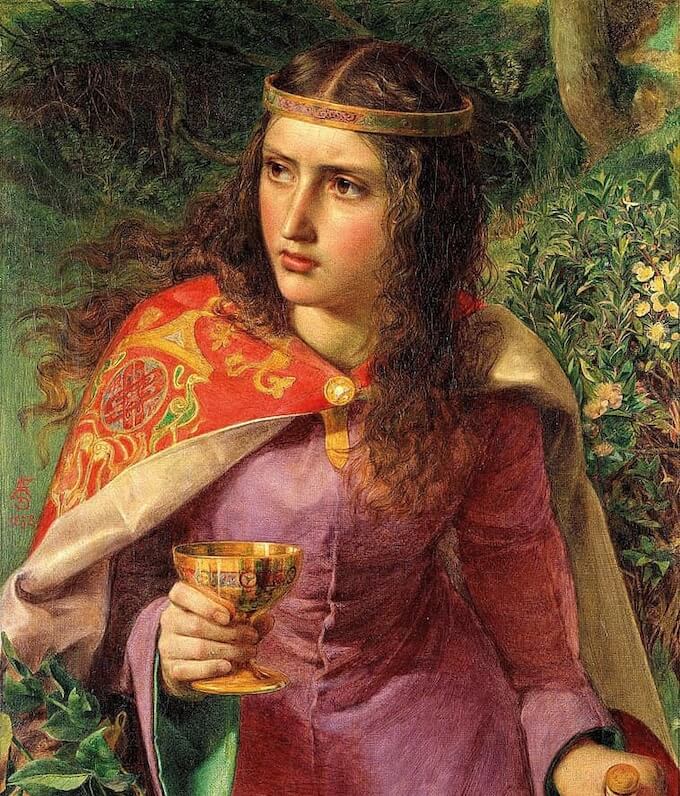
Eleanor is one of the most fascinating characters of the High Middle Ages. By far the most powerful woman in Europe at the time of the Crusades and ancestress to numerous royal bloodlines, discovering the truth about her is easier said than done. She inherited the vast Duchy of Aquitaine in Southwestern France when she was only 15 years old. Eleanor married the future King Louis VII, son of Louis VI in 1137.
Unable to produce a male heir, she not only pushed for the annulment of the marriage in 1152, but even managed to keep her title and holdings in Aquitaine, an unheard of set of circumstances for the time. She married the Duke of Normandy only a few months after her divorce and became the Queen of England in 1154 after the death of King Stephen.
This dynamic created the vast Angevin Empire which lasted from 1154-1214. Only problem, the empire included enormous tracts of land situated in France, bringing the rival kings of England and France into direct conflict. And at the heart of it all was Queen Eleanor.
But wait, it gets even more bizarre. Eleanor and Henry had eight kids, three of their sons would become kings of England. Henry the Young King, Richard the Lionheart, and the youngest son John. The legends about Robin Hood and the signing of Magna Carta played out during the reign of John, one of, if not the most reviled of all English Monarchs.
Now the complicated part of the story is that three of the kings sons rebelled against their father in 1173 with the help of Queen Eleanor. Her husband King Henry imprisoned the Queen for this betrayal in 1173, and she was only released in 1189 when her son Richard the Lionheart ascended to the throne.
King Richard I, in turn not only had to fight against his co-crusader King Philip of France, son of King Louis VII, but against his own younger brother John. After the first king of Jerusalem, Godfrey of Bouillon, Richard the Lionheart is the most famous crusader of this period.
Eleanor was remarkable in more ways than one. She was present at Vezelay Abbey, the church said to contain the relics of Mary Magdalene, when Saint Bernard of Clairvaux called for a second crusade in 1146 in response to the fall of the crusader kingdom of Edessa in 1144. This was the first major setback the crusaders suffered since taking control of Jerusalem and surrounding areas in 1098/9.
Not only was she present, but ended up joining her husband King Louis as part of the Second Crusade. The expedition was a failure which contributed to their estrangement. Only 40 years later Jerusalem fell to Saladin in 1187. The Third Crusade (1189-1192) was called to avenge this unthinkable set of circumstances, God abandoning the Latin Catholic Crusaders in favor of the Muslim Saracens. It was partially successful in recapturing some of the Holy Land, but ultimately failed to wrestle back Jerusalem, the jewel in the crown.
One of the main reasons for its failure was the issues stemming from the marriage of Eleanor to Henry and the creation of the Angevin Empire. France and England just couldn’t get it together to face a mutual enemy in Saladin. They tried, but it was half hearted and doomed from the start. The King of France, Philip Augustus was a wily character that would go on to play an enormous role in French history. He undermined the Third Crusade by helping Richard the Lionheart’s younger brother John to steal the kingdom while he was on Crusade.
Some time just before her imprisonment by her husband, King Henry, for helping their sons rebel against him, Eleanor spent about five years at her Duchy of Aquitaine (1168-1173). It was during this time that the Golden Myth was born, Eleanor’s influence on the Grail legends, courtly love, and support of the troubadours, art, poetry and literature. Her grandfather was one of the first troubadours to spread the ideals of courtly love from Catalonia in Spain to southern France.
Scholars aren’t convinced about her role in the movement, in the same way they aren’t convinced about the Black Legend. Because she was such a powerful woman, many stories emerged about her. She committed incest with her uncle, she was an adulterer, she wore men’s clothes, she rode bear-breasted into battle, she was the legendary Melusine, half woman half snake.
Aquitaine and Southern France wasn’t really part of France at the time and spoke their own language and had their own laws based on Visigothic and Roman law. Women could inherit land, run their own households and many other details that radically differed from the laws in the North. Women were generally more empowered in the South.
To be continued…
Artwork Frederick Sandys 1858
