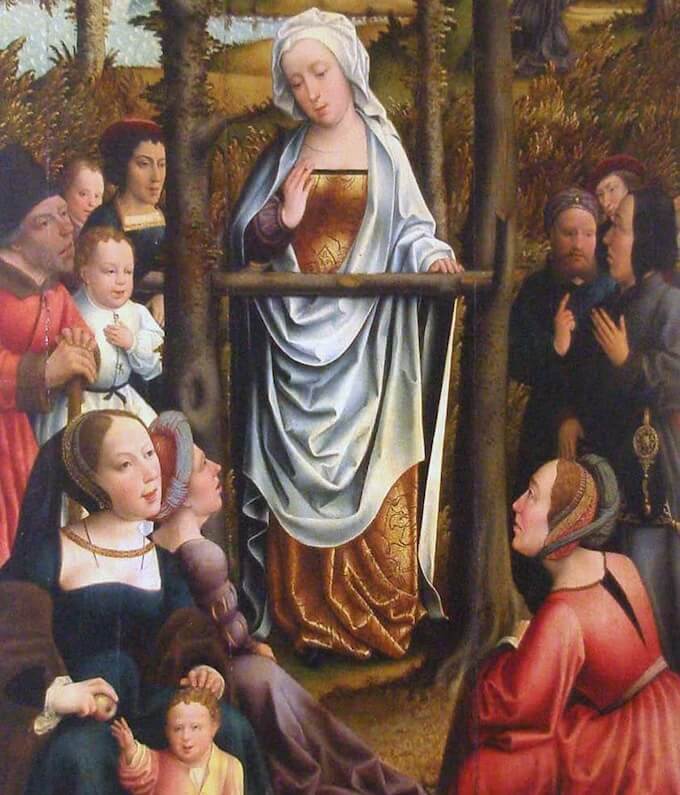
EPHESUS, VEZELAY OR SAINTE-BAUME? The monks of Vézelay in central France were the first Catholic Christians to claim ownership of the relics of Mary Magdalene. A miraculous discovery in the middle of the 11th century led to the creation of the magnificent Vézelay Abbey between 1120-1150. Pope Urban ll planned on announcing his call for the First Crusade at La Madeleine in 1095, only to change his mind and use the Coucil of Clermont for this purpose.
Saint Bernard of Clairvaux in the company of kings and queens preached for a Second Crusade from Vezelay in 1146. Richard the Lionheart and Philip ll of France spent three months at the Abbey before departing for the Holy Land and initiating the Third Crusade in 1190. Vezelay was one of four major starting points for the pilgrimage to Santiago de Compostela in north-western Spain.
Before the Great Schism between Greek and Latin Christianity in 1054, Mary Magdalene’s relics were said to reside in Ephesus, and was later removed to Constantinople. For almost 1000 years the Eastern Orthodox Church was in charge of her relics. Gregory of Tours, the father of French history, who recorded events during the Merovingian period, confirmed that her relics were kept in Ephesus. He lived between 538-594 AD, and did not mention Mary travelling to France or retiring to a cave in Sainte-Baume, close to Marseille.
It was during this period that Pope Gregory (540-604) branded Mary Magdalene as a repentant prostitute by equating her with the unnamed sinful woman that anointed Jesus in the Gospel of Luke. Gregory connected the seven demons driven out of Mary Magdalene with all seven of the deadly sins, with particular focus placed on lust.
The Golden Legend written in 1260 by Dominican friar Jacobus de Voragine was the first comprehensive story about Mary travelling to France. According to him, sometime after the crucifixion Mary and a group of people were put in a rudderless boat in the Mediterranean Sea to die. They miraculously survived and washed ashore at Marseille in southern France. Mary is said to have converted the pagans to Christianity and then retreated to a cave in the desert in Provence to spend the last 30 years of her life alone as a penitent ascetic. Mary was said to be visited by angels that would raise her up to hear their songs in heaven. Saint Maximin, the local bishop that traveled with her from Palestine in the rudderless boat visited her on the last day she was alive to administer the Eucharist.
The Golden Legend confirmed that her relics were kept at Vezelay. It was only in 1279 that her ‘true’ relics were discovered in Saint-Maximin-la-Sainte-Baume. With the blessing of Pope Boniface VIII, a massive Basilica was erected by Charles ll of Anjou, King of Naples. The Basilica of St Mary Magdalene was placed under the control of the Dominican order in 1295. The Dominicans oversaw the mass murder of the Cathars and others heretics during the Albigensian Crusade and were in charge of the Medieval Inquisition.
The Three Mary’s arriving in France by boat stems from the High Middle Ages and more than one version exists. She either goes to Marseilles, or to Saintes-Maries-de-la-Mer. The legend of Saint Sarah, the supposed daughter of Jesus and Mary only surfaced at the start of the 16th century. Overwhelming evidence exists that Sara or Sarah the Black, is in fact the Mother Goddess Kali found in Hindu beliefs.
None of the Grail legends mention Mary travelling to France and in fact name Joseph of Arimathea as the one to take the Grail to Glastonbury in Britain. Although the legends of her arrival started during the Crusades, they focussed on her life as a preacher and penitent, a reformed prostitute saved by the grace of Jesus. The Dominicans made sure to control the narrative around her comings and goings as they understood her significance to the Cathars of Southern France. She was not mentioned as the Apostle to the Apostles, a title bestowed upon her by the Cluniac monks of Vezelay.
Penance became her lot. Whipping herself, suffering, cleansing her soul that had been tainted by her life as a prostitute. They made her the Patron Saint of Prostitutes, a fallen woman that changed her ways to become the standard bearer of penance.
The legends of Mary Magdalene and Jesus being married and having children, the bloodline theory, only surfaced in the last 50 years or so. Dan Browns Da Vinci Code was published in 2003. He used others peoples ideas, the Holy Blood and the Holy Grail published in 1982, and the Templar Revelation published in 1997, to write a two billion dollar bestseller.
None of the Nag Hammadi Gospels discovered in Egypt mention a bloodline or any children, and neither do the Dead Sea Scrolls. The Gnostic Gospels mention Mary as being the companion of Christ a number of times, and that he used to kiss her, but no marriage or children. Of course it makes perfect sense that they could have been married and had more than one child, it’s almost logical, but not according to the Church. Jesus was a Virgin, and Mary a reformed prostitute.
Master of the Magdalen – early Netherlandish painter 1483-1527