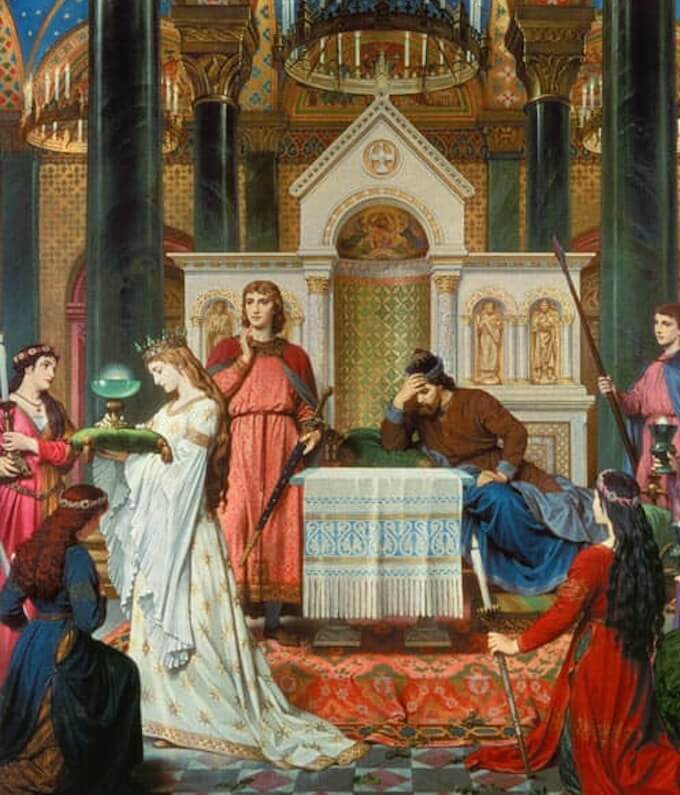
This was the question Percival should have asked the Fisher King in Chretien of Troyes legend, – whom does the Grail serve? Alternatively as expressed in Wolfram Von Eschenbach’s Parzival, – uncle, what is it that troubles you? He asked neither and therefore condemned the king and the land to remain trapped in a barren waste land. This lack of inquiry and compassion creates the need to embark on the Grail Quest, to right the wrong unknowingly committed by a naive Percival. He was advised to mind his manners and not ask too many questions, advice he should not have heeded.
In Chrétien’s version we never discover if the Knight completes his quest as the story ends prematurely. In Wolframs version the Knight succeeds and not only heals the Fisher King and the land, but takes up his position as Grail King. The Keeper of the Holy Grail can trace his lineage all the way back to Joseph of Arimithea, the original protector of the sacred object. A long line of kings fulfilled this role until tragedy struck the Grail King to render him impotent and unable to fulfill his duties, hence a new Grail Keeper was required to heal the land.
In the later versions of the legend, Percival is replaced by Galahad as the Grail Hero that saves the day, a twist that will be unpacked in the next post. The focus of this post is the Fisher King and the nature of his wound. It is quite clear that he was injured in the groin area and therefore couldn’t produce an heir, leading to a general impotence that affected everything and everyone in the Grail castle and surrounding territory.
In later versions an explanation of the wound is provided in the form of something called ‘the Dolorous Stroke’. The Knight Balin uses a magical spear to stab the king in his groin after a dispute turned violent. This action leads to the incapacitation of the Grail king. It is not altogether clear what the GK did to deserve such a harsh punishment as stories vary. He is referred to at times as the Sinful King for either engaging in forbidden love, marrying someone other than prescribed by the Grail, and even breaking the Grail Code by getting married in the first place, something the Keeper was not supposed to do.
Scholars have pointed out the multitude of similarities between the Fisher King and Bran the Blessed of Celtic myth. Even the sacred objects kept at the Grail Castle mirror those found in Irish legends. The Stone of Destiny, the Cauldron of Plenty, the Sword and Spear of Lugh.
The obvious similarities between the cyclical nature of the seasons have also been highlighted. The land is deep in the grips of winter and require the redeeming qualities of the sun to break the spell in order for spring and fecundity to return.
What makes the Grail legends so complicated is the fact that a story of pagan origin was slowly over time transformed into a Christian one.
The Post-Vulgate Cycle (1230-1240) was a major reworking of the Lancelot-Grail cycle (1210-1235) which itself was a reworking of Robert de Boron’s Christianisation of the Grail (1195-1210), which changed the original story written by Chretien of Troyes (1182-1190). Robert directly linked the Grail to the cup used by Jesus at the Last Supper, a detail absent from the original.
Wolframs von Eschenbach’s story is the closest to the original and by far the most revealing of all the Grail legends (1200-1215). Sir Thomas Malory took all of the different English and French narratives and created the most popular version, Le Morte d’ Arthur published in 1485.
The main shift away from the original story was the introduction of Galahad as a replacement for Perceval in the Lancelot and Post-Vulgate Cycle. The Vulgate Cycle omits large sections dealing with the love affair between Lancelot and Guinevere, de-emphasizing the material in favor of the spiritual as symbolized by the Grail Quest.
This change in direction is said to have occurred due to the influence of the Cistercian Order founded by Saint Bernard of Clairvaux. Saint Bernard was responsible for co-writing the Latin Rule, the moral code of the Knights Templar. The archetype embodied by Galahad was closer to the ideal of Holy Warrior Monk than the earlier portrayals of Perceval and Lancelot. Perceval was married and Lancelot had an adulterous affair with King Arthur’s wife Guinevere.
These were not qualities they wanted people to associate with the Grail Quest, preferring a celibate virgin knight to be the one to finally achieve the Grail. That’s also why miracles replaced magic and a much clearer boundary between good and evil was established. The subtle nuances of characters being both helpful and harmful, mundane and profane, were replaced by moral rigidity and spiritual dogmatism.
Distorted beliefs about what it meant to be ‘pure’ became part and parcel of the Grail Quest, setting an unrealistic standard and in that way becoming fully Christianized. Like Jesus, Galahad was sinless and perfect.
Parzival and Anfortas: Ferdinand Piloty the Younger 1885