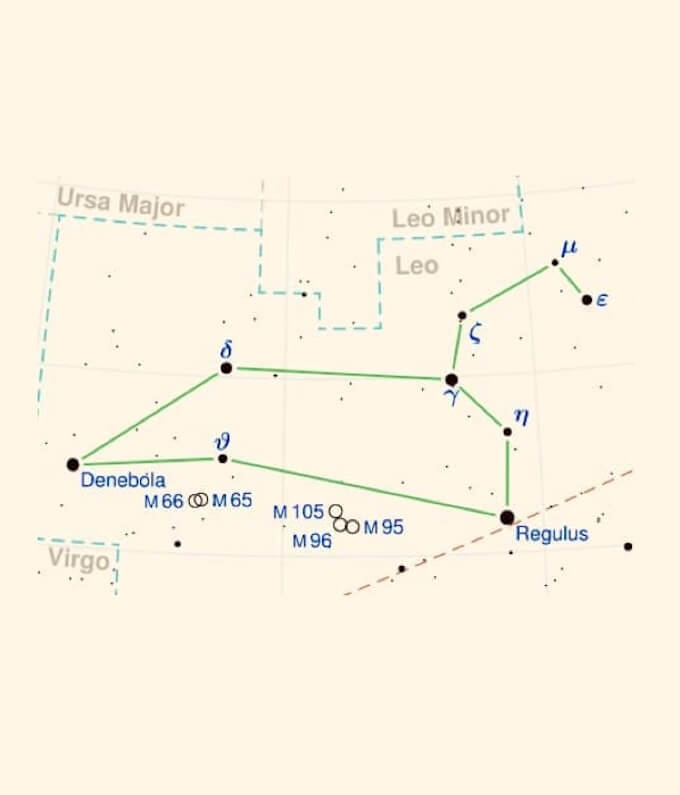
The brightest star in Leo, the 21st brightest in the night sky, Regulus is less than half a degree from the ecliptic, closest of all major stars. What this means is that Regulus can be occulted by the Moon, Venus, Mercury, and even some asteroids. Occultation or occulted is to be hidden, the true understanding of the word, occult. Nothing sinister or evil, merely hidden from view.
Known as – the King, Great, Mighty, Centre, by various cultures, Regulus was one of the four Royal Stars of ancient Persia. It was the guardian of the northern sky and appeared during the summer solstice, as Aldebaran guarded the east, Antares the west, and Fomalhaut the south. These four stars helped the Assyrians map the twelve signs of the Zodiac.
Regulus was considered the most important as it was found in Leo and connected to the Royal house and rulership in Persia. It is more than likely that after the Babylonian captivity the Hebrews adopted the Lion as a symbol of the Tribe of Judah, the royal house of Israel.
Because Jesus was said to be the Messiah and King of the Jews, supposedly tracing his lineage back to King David, he was also known as the Lion of Judah, a title given to him in Revelations. Connecting Jesus to the constellation of Leo and the bright star Regulus is rather straightforward. This would have been even more obvious in the past, but due to the Precession of the Equinoxes, the helical rising of Regulus now occurs late in the first week of September, not August.
The sun is currently in Cancer, not as many wrongly assume, Leo. In tropical astrology the date provided is 23 July – 22 August. The sun would have entered Leo very close to the helical rising of Sirius around 19-22 July. For the ancient Egyptians this was the New Year and announced the flooding of the Nile. Sirius was worshipped as Sopdet and later still as the goddess Isis.
In contrast, the ancient Greeks associated the rising of Sirius as a bad omen, accompanied by drought, heat, famine, lethargy, disease and madness. The period between, and after, the helical rising of Sirius around 22 July and the Transfiguration of Jesus on 6 August, was described as the Dog Days because of the Dog Star that follows Orion the Hunter. In Chinese Feng Shui it is known as the Great Heat, the most intense period of summer.
If all of these factors are taken together, it makes sense that the church chose 6 August as the date of the Transfiguration of Jesus. The Sun in Leo, coupled with the helical rising of both Sirius and Regulus, makes for powerful symbolism to replace pagan ideas related to Lughnasadh and the First Fruits festival after the harvest.
Although the sun causes drought and famine in some areas, it also provides the required light and heat for plants to grow in order to nourish the people. The interplay between the earth and the cycles of the sun forms the foundation of most ancient myths that deal with life, death, and rebirth. The descent, search, and ascent of Persephone being a perfect example.