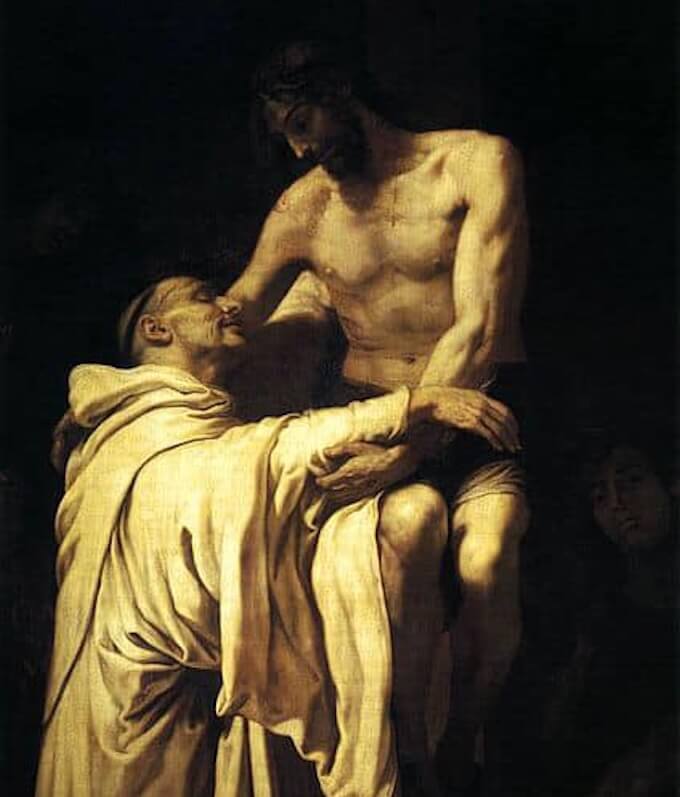
ST. BERNARD OF CLAIRVAUX 1090-1153: Bernard was canonised 21 years after his death, a perfect example of just how influential he was during the High Middle Ages. Although the Knights Templar were most probably created much earlier than the official date provided,1128/9, at the Council of Troyes, it was St. Bernard’s wholehearted endorsement that helped transform them into the most powerful Military Oder of the Crusades. Bernard and the founder of the Templars, Hugues de Payens introduced the Latin Rule consisting of 72 ‘laws’ or rules the Knights were expected to adhere to.
The most important being, CHASTITY AND CELIBACY. Knights of the brotherhood were to avoid women at all costs and could not be married. Dormitories were even lit at night and the knights ordered to sleep fully clothed to prevent any sexual sins from occurring. This attitude coincided with First Lateran Council of 1123 that made celibacy for priests compulsory. Throughout the centuries the Catholic Church tried to implement this tenet without much success.
LATERAN COUNCIL:
Clerics are obliged to observe perfect and perpetual continence for the sake of the kingdom of heaven and therefore are bound to celibacy which is a special gift of God by which sacred ministers can adhere more easily to Christ with an undivided heart and are able to dedicate themselves more freely to the service of God and humanity.
Canon 3: We absolutely forbid priests, deacons, and subdeacons to associate with concubines and women, or to live with women other than such as the Nicene Council (canon 3) for reasons of necessity permitted, namely, the mother, sister, or aunt, or any such person concerning whom no suspicion could arise.
Canon 21: We absolutely forbid priests, deacons, subdeacons, and monks to have concubines or to contract marriage. We decree in accordance with the definitions of the sacred canons, that marriages already contracted by such persons must be dissolved, and that the persons be condemned to do penance.
Hugues pleaded with Bernard to write another document a few years later as many knights were having doubts about the idea of an order of monks devoted to military combat. They were worried whether there was a genuine theological justification for being both monk, and warrior. Bernard responded by writing Liber de Laude, a Book to the Knights of the Temple, in praise of the new knighthood.
Bernard compared them to regular knights that were vain, prone to wanton violence and pointlessness, as opposed to the Templars that were noble, following a higher spiritual calling, fearless and pure of heart. He also linked the Templars to the holy places in the Crusader States and presented them as the custodians of Christian heritage.
Bernard encouraged them by proclaiming the Knights were fighting a twofold war, both against flesh and blood and a spiritual army of evil. The souls of the Knights were protected by the armour of faith just as armour of steel protected them from their enemies.
‘The Knights of Christ may strike with confidence and die yet more confidently, for he serves Christ when he strikes, and serves himself when he falls.’
The Templar headquarters were to be based in Jerusalem, reaffirming their mandate as protectors and defenders of the Holy Land. Templar Knights, as all other crusaders would gain absolution from sin and attain grace by killing, and dying, in the Name of God.
After the siege of Edessa in 1144, Bernard preached for a Second Crusade, culminating at Vézelay Abbey in 1146. There wasn’t much enthusiasm at the time, but after his sermon lit the crowd on fire, there was no turning back. Eleanor of Aquitaine and her first husband Louis of France were both present at Vézelay. The Crusade was a disaster and Bernard shouldered the blame for its failure. In a letter written to the Pope offering his apology, he pointed to the sins of the crusaders being the cause of their misfortune in the Holy Land. Saladin claimed Jerusalem not even forty years after the failed Second Crusade.
In his spare time, St Bernard also preached against heresy and combated the Cathars of Southern France. In 1147 he called for the Wendish Crusade against Western Slavs, ‘until such a time as, by God’s help, they shall either be converted or deleted’.
Bernard was also very influential in helping Portugal become Portugal during the long period of the Reconquista. The Alcobaca monastery in central Portugal was given to Bernard as a gift by the first Portuguese king, Afonso Henriques in 1153. The Knights Templar played an enormous role in the Reconquista and were rewarded with major tracts of land, but even more importantly, were not hunted down and killed when they fell out of favor in 1307-1312. All they had to do was change their name. Tomar was the headquarters of the Templars in Portugal.
Christ Embracing St. Bernard Francisco Ribalta. St. Bernard preaching the Second Crusade Emile Signol 1804-1892

