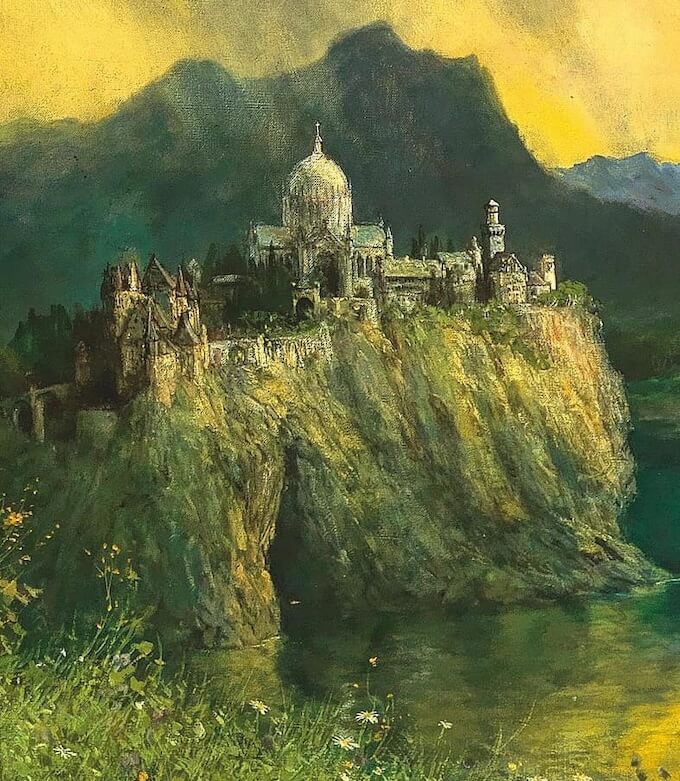
One of the enduring mysteries associated with the Grail legends is the unknown location of the Grail Castle. Referred to as Corbenic in the Lancelot Cycle, and Munsalvasche, or Monsalvat by Wolfram von Eschenbach in Parzival. Mountain of Salvation.
The Temple Mount in Jerusalem is the most obvious candidate as the Templars were in charge of the Holy Site. The only problem, Jerusalem was lost to the Saracens in 1187, at least a few decades before Wolfram wrote Parzival. Jesus was crucified on Golgotha to save humanity from sin.
In 1906, the Rosicrucian French writer Josephin Peladan theorised that the Cathar stronghold of Montsegur in Southern France, was the same place as Monsalvat/Munsalvasche, mentioned as the Grail Castle by Wolfram in Parzival. He also speculated that the Cathars were in possession of a secret treasure, the Holy Grail, or some form of esoteric knowledge. The Nazi Otto Rahn (1904-1939), wrote a book ‘the Crusade against the Grail’ in which he interprets Wolframs Parzival as a thinly disguised account of the Albigensian Crusade 1209-1229.
In the Jungerer Titurel written in 1272, Albrect von Scarfenberg calls the Grail King – Titurel, Perilla. This is a Latin version of Pereilla, the surname of Raymond of Pereilla, the person that restored and fortified Montsegur in 1204. In 1233, Montsegur became the seat and head of the Cathar Church. 10,000 French troops besieged the fortress for nine months until they finally managed to subdue the Cathars in March 1244. Before surrendering to the French Crusaders, a two week truce was arranged. It is during this period that legends say a small group of Cathars escaped with their treasures by slipping through French lines.
More than 200 Cathars refused to convert and were burned on mass for their obstinance/faith. This act has been compared to the mass suicide of Sicarri rebels at the end of the Jewish-Roman War in 73 AD. Masada was an ancient fortification in southern Israel, the last remaining pocket of resistance.
There is no doubt that some of the Crusaders were not completely sold on killing the Cathars and the Knights Templar refused to participate in the Albigensian Crusade. This could have been because of the Crusades taking place in the Holy Land or because they were sympathetic to the Cathar cause. Many Knights came from the Languedoc and the Templars owned enormous amounts of land in the region. The 6th Grand Master of the Templars, Bertrand de Blanchefort, was said to come from a family of Cathars and many Templars were in fact Cathars, not Catholics.
The Militia of the Faith of Jesus Christ was created in 1121 to fill this gap. They received permission from Pope Honorius lll to fight in the Languedoc, the same as the Templars were granted permission to fight in the Holy Land. They were also allowed to observe the ordinances of the Knights Templar, even though they were not Templars.
Another possibility for the Grail Castle could be somewhere in the mountain range of Montserrat in Catalonia, Spain. The Benedictine Abbey of Santa Maria de Montserrat was established in 1025, 999 years ago. The Languedoc was more Catalan than French, one of the main reasons for the Albigensian Crusade, to incorporate the area into the French kingdom. The Templars were not persecuted in either Spain or Portugal during the 14th century.