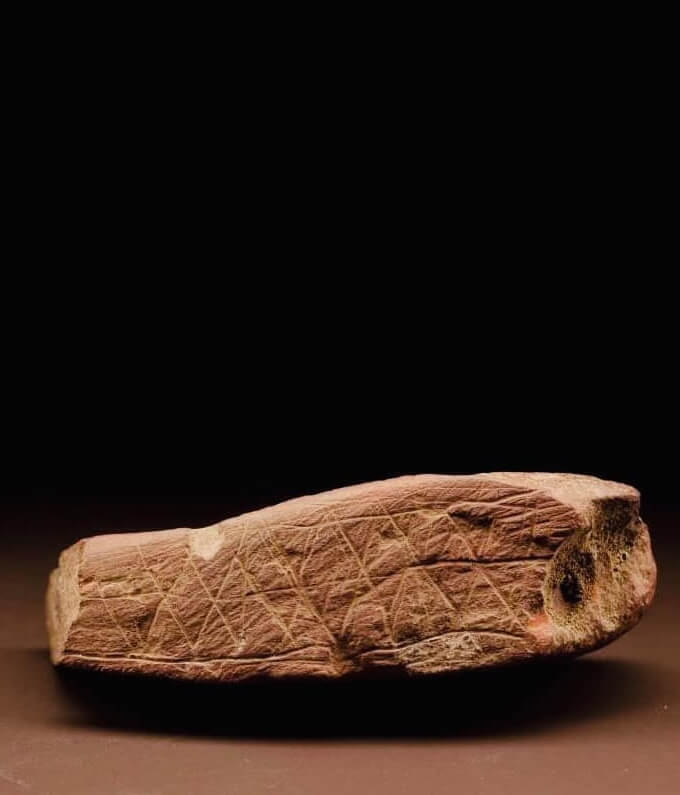
Until the 1990’s, the development of complex human behavior was thought to have occurred around 40,000ya in Europe. The discovery of an engraved piece of ochre in a cave 300km east of Cape Town, South Africa, radically altered these beliefs. The findings in Blombos cave stunned archeologists as the ochre was dated to 77,000 ya, almost twice the age of the rock art found in Europe. To compound matters, the ochre wasn’t an isolated example, but one of many engraved pieces found over a wide area.
To add to this was the use of the same geometric pattern, the exact same symbol, not just random scratches but something that obviously represented a belief or concept. The ability to think symbolically is ultimately what makes us truly human. The understanding that a symbol represents something else, an idea or concept that is embodied by the symbol, but is not the actual thing itself, is viewed as modern behavior. Some archeologists have gone as far as to suggest the discovery shows the first signs of spirituality and consciousness.
How old are humans, how long have we been on earth? The latest research suggests, wait for it, at least 300,000 years. Yes certain religious groups speak of the earth itself being only 6000 years old, but even scientists are shocked at the true age of Homo sapiens. We can add the cutting edge research being done on DNA and the distribution of humans across the globe, coupled with the fact that Homo sapiens occupied the earth at the same time as Neanderthals, Denisovians, the Hobbit people of Indonesia, and possibly some other unknown species.
What is even more fascinating is the fact that the indigenous peoples of Southern Africa have ‘purer’ DNA compared to Europeans. The intermingling of humans with other humanlike species, (not aliens), has left clear genetic evidence in our DNA. So not only did modern human behavior develop in Africa, but Africans have less ‘polluted’ DNA than Europeans. They are more human, a very strange concept indeed.
In much the same way that Christians and other religions decorate and adorn their sacred churches and temples, so did the ancient peoples worship in caves. They painted fantastic figures, shamans, animals, geometric patterns, and other symbols on the walls of the caves. It is obviously extremely difficult for us to confidently state what these different symbols actually mean. What is easier to do is look at the art found in cathedrals and churches and to match the symbols with the beliefs of the culture under discussion, Christianity in this instance.
And here we are confronted with the Holy Incongruence again, the glitch in the Matrix. Expecting to find certain symbols that mean something that has collectively been agreed upon, only to discover symbols that mean something altogether different. Understanding these symbols from an educated perspective transforms their meaning and unveils a much deeper, hidden level of knowledge found in the Bible. Humans have been refining their beliefs and knowledge for tens of thousands of years.
If we allow ourselves to think out of the box of our condition, we will discover a very highly evolved understanding of the universe grounded in geometry, mathematics and astronomy. Symbols veil this knowledge, by decoding their true meaning through stripping away all the superstitious beliefs associated with these symbols do we arrive at a place free from our conditioned beliefs, opinions and prejudices.