One of the foundational figures of alchemy, Cleopatra lived sometime during the third or fourth centuries in Alexandria, Egypt. She was named as one of four women to have discovered the philosopher’s stone alongside Mary the Jewess. Women contributed a great deal to the emerging art of alchemy, both in a practical sense, and to the inner transformation of the individual. The alchemist Zosimos of Panopolis wrote that the angels taught women the arts of metallurgy.
“The ancient and divine writings say that the angels became enamoured of women; and, descending, taught them all the works of nature. From them, therefore, is the first tradition, chema, concerning these arts; for they called this book chema and hence the science of chemistry takes its name.”
Enoch also mentions that the angles taught women all different types of things, although he does have a much more negative slant than Zosimos. During the Hellenistic period, women were held in high regard and their intelligence praised and valued. Women contributed to mathematics, astronomy, and the emerging art/science of alchemistry.
The theme of women being at the forefront of knowledge and discovery traces all the way back to Eve in the Garden of Eden. Imagine how much more evolved humanity would have been if women were given equal opportunity to study and participate during the last one and a half thousand years or so.
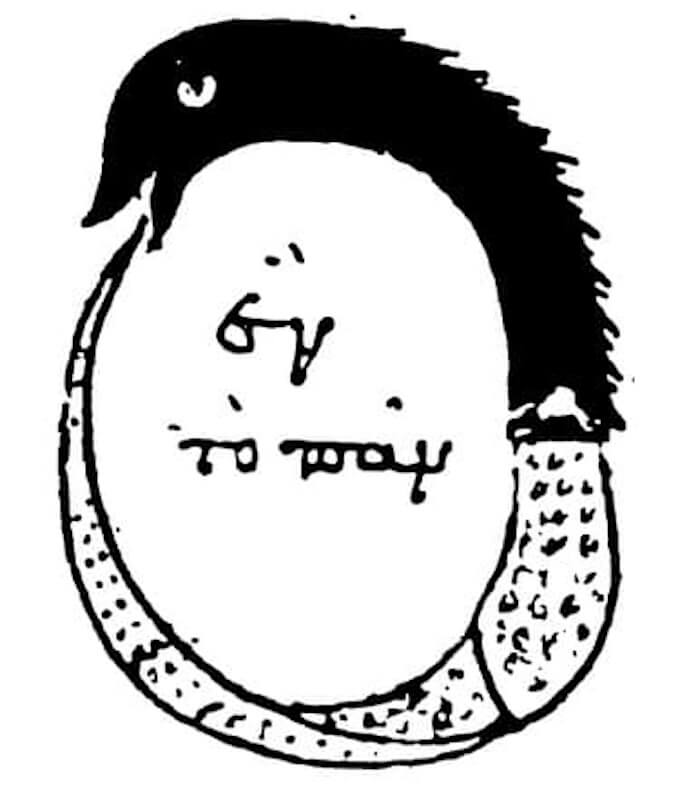
The Chrysopoeia of Cleopatra is a short Alchemical work attributed to Cleopatra the Alchemist. On the front cover is an image of the Ouroboros, the serpent eating its tail, a symbol of eternity and the cyclical nature of life. The words ‘Hen to Pan’, the all is one, can be found on the cover, a popular concept related to Hermeticism.
Chrysopoeia is Ancient Greek for gold-making, the transformation of the individual from a lower to a higher level of consciousness.