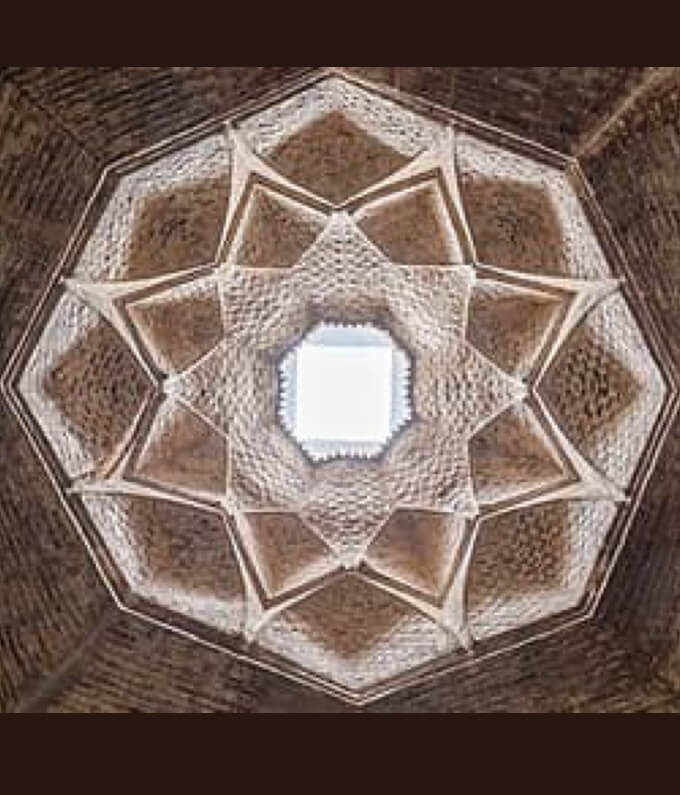
Christianity and Islam chose very different paths regarding the preservation of knowledge. The one associated knowledge with evil, and the other associated knowledge with wisdom. After the destruction of the Great Library of Alexandria in 391 AD, and the closure of the Platonic Academy in 529 AD by Emperor Justinian, an insidious fog of ignorance settled over Christendom. The Dark Ages.
The rise of Islam in the seventh century, and in particular, the Abbasid Caliphate that replaced the Umayyad dynasty in 750 AD, set in motion what would become known as the Golden Age of Islam, a 500 year period of excellence. The House of Wisdom, a grand library created in Baghdad sometime at the end of the eighth century, was the focal point of this cultural renaissance. Successive caliphs encouraged scholars to translate books on topics as wide ranging as astronomy, mathematics, optics, philosophy, astrology, medicine, alchemy, and physics. They even supported Egyptology and the study and preservation of the pyramids and other ancient artefacts.
The Translation Movement started with works in Greek, Indian and Persian, later to include Syriac and Chinese. All the best scholars not only translated these topics into Arabic, they expanded upon them. While the Christian controlled areas stagnated due to superstitious indoctrination, Muslim lands thrived because of the advancements made in science and reason.
Christians first came into contact with this knowledge in the Iberian Peninsula during the Reconquista. The Toledo school of translators copied works from Arabic and Hebrew into Latin, and these translations made their way to Cluny Abbey, and the School at Chartes in France. At almost the same time, the Crusaders conquered Jerusalem, which in turn exposed them to centuries of Arabic learning and science. The sacking of the Imperial Library of Constantinople during the fourth crusade by Latin Christians led to an influx of newly acquired knowledge into Europe.
The destruction of libraries and the imprisonment, torture, and murder of intellectuals, philosophers and scholars, have been repeated throughout the centuries. Educated and intelligent people tend to pose a problem to the ruling class. Even Islamic caliphs started to view reason as dangerous and retreated back into a more superstitious understanding of the world.
Fortunately the Renaissance exploded in Florence under the guidance of Cosimo de Medici. Patron of the arts and culture, Cosimo sent book buyers all over the world to collect rare manuscripts. He opened the first public library in Florence, 1444, and also re-established Plato’s Academy that was shut down in 529 AD.
Some scholars refer to it as the Hermetic Renaissance, a side branch of the Renaissance. The study of alchemy and astrology evolved into chemistry and astronomy during the 16th century. This in turn led to the Invisible College, Rosicrucians, and ultimately the Royal Society that was founded in 1660. The Scientific Revolution opened the path for the Enlightenment and Age of Reason of the 18-19th centuries.
If it wasn’t for Islamic scholars, most of the knowledge of the ancient world would have been lost. Human evolution would have been set back hundreds if not thousands of years. We underestimate how long it has taken to arrive at this point in our collective journey. Many thousands of years of observation and study almost disappeared into a deep black hole of nothingness.