Sport might seem arbitrary to some, lacking in any real depth beyond winning and losing. This I can assure you, is not the case when it comes to South Africa and the Springbok rugby team. It would not be an overstatement to boldly declare that without the enormous influence of rugby, South Africa would have gone up in flames, a number of times.
It took the vision of Nelson Mandela to recognise the important role rugby played in the lives of the Afrikaner community. Many wanted to replace the Springbok emblem with an alternative symbol, yet Mandela refused. He wanted to build a nation, not further divide it.
Mandela became president in 1994, and the goodwill generated by the fall of Apartheid led to World Rugby choosing to host the 1995 edition in South Africa. Due to sanctions and boycotts, SA did not participate in the 1987 or 1991 editions.
Because of segregation, rugby was mainly a white sport, and football a black sport, players didn’t mix. In fact it was illegal for a white and black player to compete in the same team. There was only 1 black player out of 15 in the team, when against all odds, the Springboks defeated the mighty All Blacks of the legendary Jonah Lomu in 1995.
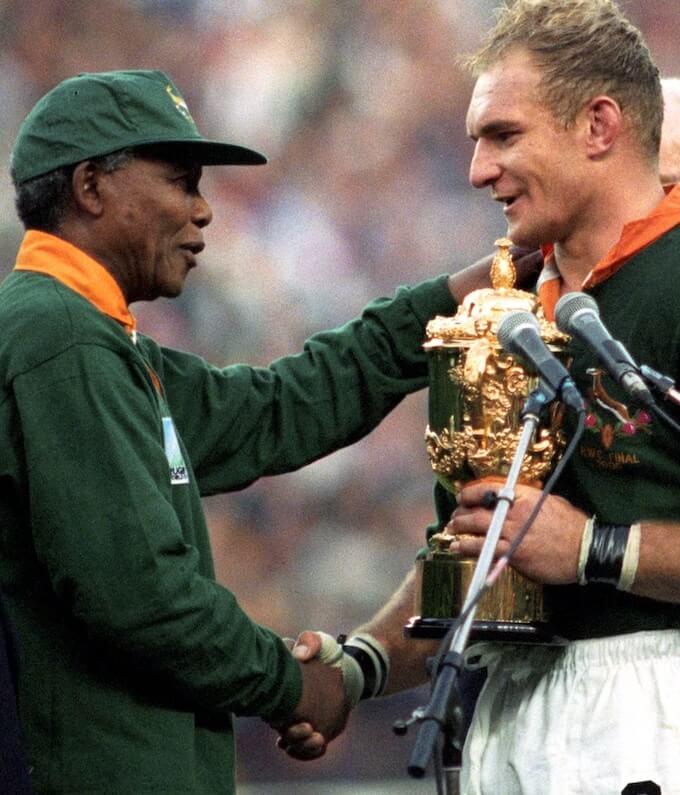
For the very first time in the history of South Africa, all races celebrated and united as one, a truly remarkable set of circumstances. Civil War had been brewing throughout the early nineties, yet as the image conveys, Mandela handing the trophy to a blond and blue eyed Francois Pienaar, changed everything.
Unfortunately as with most things in life, they shift, and yet they also don’t. Two steps forward, and one step back. Transformation in the sport itself was rather slow and cumbersome. 12 years after the first victory, the Springboks won the 2007 edition under the leadership of John Smith. A few more players of color participated than the sole player of 1995, yet victory was bittersweet as many black and brown South Africans were frustrated with the incremental progress.
It took a dip in form, a slide down the world rankings, and a few almighty losses against the All Blacks to finally change course.
A new coach took over in 2018 and instead of viewing African players as not being good enough, Rassie Erasmus opted to embrace the enormous pool of black and brown players that were patiently waiting for their opportunity. The mantra was all about meritocracy and not diluting the brand by just handing out caps to players that weren’t deserving. Yet this was also used as an excuse to continue excluding players of colour.
The new coach, a White Afrikaner, tore up the script and boldly went where none had dared to go before, he appointed Siya Kolisi as South Africa’s first black captain. It was a master stroke that will be spoken of in decades to come. Not only did Siya become the first black captain to lift the Rugby World Cup in 2019, he did it again four years later in 2023. Only the legendary Richie McCaw of the All Blacks had managed this feat, and he was snow white.
Siya Kolisi is now a global icon. His leadership qualities, humility, and man management is second to none. But Siya was by no means the only player of colour in the team, he was one of many. It was exactly the embrace of these players that made the sustained success possible.
The Springboks are a living example of what can be achieved when all races, shapes and sizes, unite and work towards a common goal. That’s why South Africans are not pleased with the lies and slander spread by Elon Musk and Donald Trump. The last thing we need is to fan the flames of us and them.
I invite you to look at some old videos on YouTube about the 2019/2023 victories. From the moment the boys landed at the airport, to the extraordinary scenes that played out across the length and breadth of South Africa. The management team didn’t just do one parade in the biggest city, they did multiple parades.
They took the trophy to the people, literally. From the townships to the small villages and everywhere in between. My heart fills with love and joy just thinking about it, it was truly extraordinary. While you’re at it, search for videos of the Springboks singing the National Anthem in front of their home fans, it’s spine tingling stuff.
All because of one man’s vision. Nelson Mandela unfortunately did not live long enough to see his dream of the Rainbow Nation become a reality. Yes things aren’t perfect, yes many people are struggling to survive, crime is a perpetual problem, as is corruption, nonetheless, I’d rather live in South Africa than in America.
Nkosi Sikelel’ iAfrica.
Apr 01, 2025 1:38:52 pm


