🙈FIRST, 🙉SECOND, 🙊THIRD AND 🐒FOURTH: “Look not at what is contrary to propriety; listen not to what is contrary to propriety; speak not what is contrary to propriety; make no movement which is contrary to propriety” – Analects of Confucius.
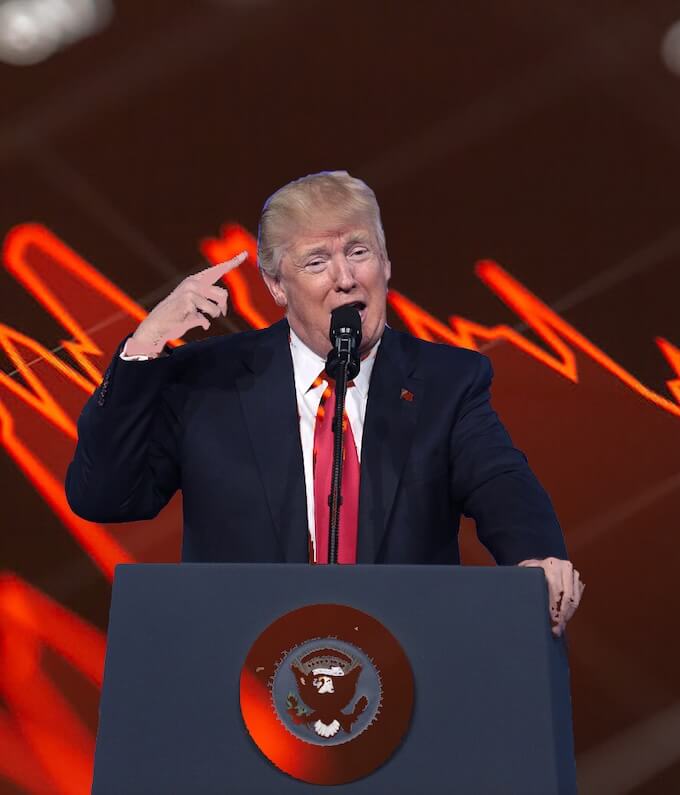
THE MARKETS ARE GOING BOOM: Since January, when the Trump administration began, US markets have lost 10% of their value, marking the worst 10-week start under a new president since George W Bush in 2001 during the height of the dot-com selloff.
Wall Street had its worst day since the height of the Covid crash after President Donald Trump’s tariffs sparked fears of a US and global recession.
Trump seems unfazed. Asked about tumbling stocks on Thursday as he boarded Air Force One to attend a golf dinner in Miami — as the Dow Jones was down 1,400 points — Trump said: ‘I think it is going very well.’
‘It was an operation. [It is] ike when a patient gets operated on and it’s a big thing. I said this would exactly be the way it is,’ he added, claiming that ‘six or seven trillion’ dollars would be coming into US.
‘The markets are going to boom… the country is going to boom and the rest of the world wants to see if there’s any way they can make a deal,’ the president continued.
$2TRILLION WIPE OUT: Wall Street was awash in red today after the President unveiled steeper-than-expected tariffs on Wednesday. For every stock that gained value, six were losing ground.
When the markets closed at 4pm in New York, the S&P 500 was down 4.84 percent, its worst day since June 2020 — as $2 trillion was wiped from an index almost every American has in their normal and retirement investments.
The Nasdaq plummeted 5.97 percent, its worst day since March 2020. The Dow Jones 3.98 percent, a headline-grabbing 1,700 point drop.
Individual stocks took an even bigger battering. Five Below was down 26 percent and Gap by 21 percent. Ralph Lauren, Dockers and Dell down 17 percent. Nike was down 13 percent. Apple down 10 percent.
A 10 percent baseline tariff on all countries will take effect on April 5, with even higher duties for China, the European Union and Asian countries that supply cheap clothes to the US. – Daniel Jones for DM.
SOUTH AFRICA hits out, as continent reels from aid cuts and tariffs. Trump’s “reciprocal tariffs” are targeting dozens of African countries, including 30% for South Africa and 50% for Lesotho. Many of these nations are already grappling with the effects of US foreign aid cuts, which provided health and humanitarian assistance to vulnerable countries.
South Africa – like some of the continent’s other biggest economies including Nigeria and Kenya – has long had open trade agreements with the US, and the new tariffs could significantly affect existing economic ties. It is included in the long list of countries dubbed the “worst offenders” that now face higher US rates – payback for unfair trade policies, Trump says.
“They have got some bad things going on in South Africa. You know, we are paying them billions of dollars, and we cut the funding because a lot of bad things are happening in South Africa,” he said, before going on to name other countries. In a statement, the South African presidency condemned the new tariffs as “punitive”, saying they could “serve as a barrier to trade and shared prosperity”.
Several African nations are among the countries hit by sweeping tariffs announced by President Donald Trump on the US’ global trading partners.
Trump has announced a minimum 10% tariff on all imports to the US and additional “reciprocal tariffs” for 20 African countries, including 30% for South Africa.
Trump said the reciprocal tariffs were “for countries that treat us badly”.
DECLARED UNFIT FOR OFFICE: During Wednesday’s announcement at the White House, the Republican president said that the US had been taken advantage of by “cheaters” and had been “pillaged” by foreigners. “Our taxpayers have been ripped off for more than 50 years, but it is not going to happen any more,” Trump said.
“It’s our declaration of economic independence,” he added while holding up a chart showing a list of countries that charge higher tariffs on US goods, impose “non-tariff” barriers to US trade or have otherwise acted in ways US officials feel undermine American economic goals.
South Africa is included in the long list of countries dubbed the “worst offenders”, which also involve China, Japan and the European Union – that now face higher US rates – payback for unfair trade policies, Trump said.
African countries like South Africa, Nigeria, and Kenya have long had open trade agreements with the US, and the new tariffs could significantly affect existing economic ties. The tariffs come as many African countries are already grappling with the effects of US foreign aid cuts, which provided health and humanitarian assistance to vulnerable countries.
Trump announced the aid freeze on his first day in office in January as part of a review into the US government spending. US-South Africa relations have deteriorated sharply since Trump returned to power. Trump and his ally, South-Africa born Elon Musk, have singled out South Africa, in particular criticising it over its land reform policies that they say discriminate against white farmers.
Economists say the new tariffs mark a clear departure from the more open trade policies that have previously defined US-Africa relations.
By Wycliffe Muia in Nairobi for BBC. 2 April 2025
UPDATE: 4 April – 2 trillion in losses have now become 3 trillion. A billion is a thousand million. A trillion is a million million.
DOUBLE DATE: $4,9 trillion have been wiped off the value of the global stock market since Trump made his move.
TRILPE DATE – 16/4: This is all pretty embarrassing.
It’s been two weeks since President Donald Trump’s “Liberation Day” tariff speech launched a global trade war, premised on absurd math, and erased trillions of dollars in market value. Every day since has been a stream of contradictory statements and brinkmanship with no way of knowing which declarations will stick. (Not helping: The looming threat of a constitutional crisis as the White House picks fights with American courts, higher education, the entire legal profession and most of the media.)
It’s no wonder then that the rest of the world is taking a look at the United States — as a trading partner, a travel destination, a steward of the global financial market — and shaking their heads.
Even before the tariffs were announced, multiple European countries, Canada and China issued travel updates warning their citizens about potentially being detained at the US border. Canadians have been especially vocal about canceling their trips to the US in protest of Trump’s policies, including tariffs. But they’re not alone: All foreign arrivals into major US airports tumbled 20% late last month compared with the same period a year ago, according to an Axios analysis — a fact that should alarm the more than $2 trillion US travel and tourism industry.
The world’s appetite for American-made stuff is also taking a hit, especially in China, which is retaliating against Washington’s 145% tariff.
On Tuesday, Bloomberg reported that Beijing has halted all deliveries of aircraft and parts made by Boeing, that quintessentially American manufacturer that directly or indirectly supports 1.6 million US jobs.
Whether Beijing’s move is a negotiating tactic or a lasting boycott of the plane maker, it is decidedly bad news for Boeing, which hasn’t turned a profit in more than five years. But it’s great news for Boeing’s European rival, Airbus.
Commercial trucks head towards the US Customs and Border Protection entry point from south Surrey, Canada, on November 26, 2024. Canadians have been vocal about canceling their trips to the US in protest of Trump’s policies, including tariffs.
Commercial trucks head towards the US Customs and Border Protection entry point from south Surrey, Canada, on November 26, 2024. Canadians have been vocal about canceling their trips to the US in protest of Trump’s policies, including tariffs. Jennifer Gauthier/Reuters/File
It’s not just planes. The tariffs are hitting China at a moment when US brands like Apple, Nike, Tesla and Starbucks are losing market share to homemade rivals, as the Wall Street Journal reports.
That consumer rejection is an especially thorny issue for businesses.
“You see a lot of danger for US brands and US manufacturers in the current environment, both directly from retaliation by other governments, and indirectly from a very negative consumer response to American products in general,” John Gilbert, an economics professor at Utah State University, told me. “People have memories — I’m not sure how much that dissipates, even if the governments of those countries can come up with some kind of agreement.”
And of course, there’s the turmoil in the US Treasury market — the clearest, and frankly scariest, rebuke of Trump’s tariff policies to date.
ICYMI: When stocks fell in response to tariffs, the market for US government bonds — the boring-est, safest, most vanilla of assets — should have been the go-to place for investors. That didn’t happen.
Sleepy Treasuries started behaving like risk assets, a sign that investors are losing confidence in America’s ability to pay its debt and manage its economy. That’s the financial equivalent of a five-alarm fire.
Meanwhile, the value of the US dollar has been falling — another sign investors are shying away from what has historically been the market’s safe haven.
“I think this is one of the biggest ‘own goals’ to US credibility in financial markets that I’ve ever seen in my lifetime,” said Heidi Crebo-Rediker, a senior fellow at the Council on Foreign Relations, in an interview. “You can look at the global financial crisis as being a hit to US credibility in terms of financial markets, but this is different… Covid was an external shock. This comes straight out of the White House.” – CNN – Allison Morrow.
Apr 03, 2025 11:19:07 am


