AND PERSONAL INTERESTS: – A small group of reservists from Israel’s elite military intelligence unit joined a call for an immediate return of the hostages in Gaza even if it requires an immediate end to the war, in a sign of a growing protest movement after more than 18 months of war.
The public letter, with more than 250 signatories, says the war “is currently mainly serving political and personal interests and not security interests.”
“The continuation of the war doesn’t contribute to any of the declared objectives, and will lead to the death of hostages, (Israel Defense Forces) soldiers, and of innocents,” the authors wrote.
The letter was written by reservists and retirees from Israel’s elite Unit 8200, the biggest military intelligence unit. It also criticizes Prime Minister Benjamin Netanyahu’s stated plans to defeat Hamas and return the remaining 59 hostages held in Gaza.
To continue governing, the prime minister requires the support of coalition partners from far-right parties who have threatened to quit the government should the war end.
“The government didn’t take responsibility for the catastrophe, and doesn’t admit that it has no plan or solution for the crisis,” the authors wrote. “We join the call of the air crews to all Israeli citizens to take action and demand, everywhere and in any way, the return of the hostages now and the cessation of the fighting.”
The new public protest comes a day after hundreds of air force retirees and reservists published a similar letter in major newspapers in Israel, saying “the war mainly serves political and personal interests and not security interests.”
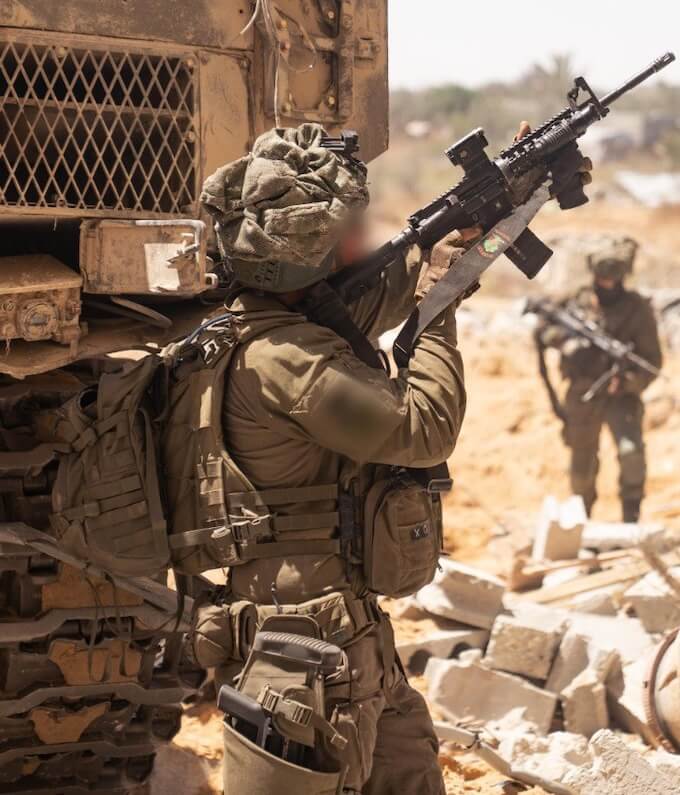
Israel has a relatively small standing military, but a much larger reserve corps upon which it relies during an extended conflict. A growing protest movement within the reserves could potentially affect the Israeli military’s ability to conduct an extended campaign in Gaza.
While the two letters criticized the continuation of the war, the signatories have not refused to serve. Within hours of the first letter’s release on Thursday, the Israeli military announced that it had fired the air force reservists who had signed the letter and was analyzing the signatures to see how many more were still in the military. An IDF official said most of the signatories are not active reservists.
The commander of the Israel Air Force, Maj. Gen. Tomer Bar, criticized the letter in his own missive published Friday.
“The messages which appear in the proclamation express a lack of trust and damage the cohesion within the force,” Bar wrote. “Such publication has no place during wartime as IDF soldiers and commanders are risking their lives.”
Netanyahu slammed the new protest letter and attempted to cast the authors as a tiny minority.
“They were written by a small group of bad apples, operated by organizations funded by foreign money, which have one goal – topping the right-wing government,” Netanyahu said in a statement, without providing any evidence of his claims of foreign influence.
But Netanyahu’s statement acknowledged that the protest letters were coming from multiple parts of the military, and mentioned a potential similar letter from the navy.
“Once again those same letters: one time on behalf of pilots, another time on behalf of navy graduates, and other times under different names,” he said.
The prime minister tried to downplay the significance of the letters despite recent polls showing that nearly 70% of the Israeli public supports an end to the war in order to free the remaining hostages.
“This isn’t a trend. This isn’t an influx. This is a small group of retired personnel, who are loud, anarchist and disconnected,” he said.
The move to clamp down on the public protest appeared aimed at stemming increasingly vocal discontent among reservists and preventing a repeat of 2023, when waves of reservists said they would refuse to serve in protest of Netanyahu’s judicial overhaul efforts.
Nearly all of those reservists ultimately answered call-ups they received after Israel was attacked on October 7, but that wartime unity has begun to falter as the war has dragged on. – CNN –
HELL ON EARTH: – The head of the International Committee of the Red Cross (ICRC) has told the BBC that Gaza has become “hell on earth”, as Israel’s military assault there continues.
Mirjana Spoljaric’s comments come on the same day the UN human rights office warned that Israel’s tactics were threatening the viability of Palestinians continuing to live in Gaza at all.
The ICRC is the guardian of the Geneva Conventions – internationally agreed rules of conduct in war – and normally only speaks confidentially to warring parties when it thinks violations are taking place. But Ms Spoljaric has now said publicly that what is happening in Gaza is an “extreme hollowing out” of international law.
Israeli bombardment has killed 1,542 people since it renewed the war on 18 March, the Hamas-run health ministry in Gaza says. The Israel Defense Forces (IDF) has also issued evacuation orders that have forced nearly 400,000 people to move. Israel has also imposed a complete blockade on the entry of food, medical supplies and all other goods since 2 March.
Israel insists it always follows international law in Gaza, and has also argued that the particular nature of this conflict, with Hamas fighters hidden among the civilian population, mean collateral damage can sometimes happen.
Israeli ministers insist there is enough food in Gaza and say the bombardment and seizure of territory aims to pressure Hamas into releasing the hostages it is still holding, whom it kidnapped during the 7 October 2023 attack.
Under the fourth Geneva Convention, occupying powers, as Israel is in Gaza, must ensure civilians have food and medicine, and protect hospitals and health workers. The convention also prohibits the forcible transfer of entire populations from occupied territories.
“No state, no party to a conflict… can be exempt from the obligation not to commit war crimes, not to commit genocide, not to commit ethnic cleansing,” Ms Spoljaric said.
“These rules apply. They are universal.”
Civilians were bearing the brunt of a relentless pursuit of military objectives, she added, being displaced multiple times, and their homes reduced to rubble. Of 36 recent airstrikes verified by the UN human rights office, all those killed were women and children.
Israel has strenuously denied accusations it is committing genocide or genocidal acts in Gaza.
Israel’s military said it was looking into an attack that killed members of one family in the city of Khan Younis and said it had struck 40 “terror targets” across the territory over the past day. The ICRC’s comments are the latest in a chorus of concern coming from the UN and other agencies.
On Friday the UN human rights office spokeswoman Ravina Shamdasani said the “cumulative impact” of the IDF’s conduct meant “the office is seriously concerned that Israel appears to be inflicting on Palestinians in Gaza conditions of life increasingly incompatible with their continued existence as a group in Gaza”.
Israel was continuing to bomb tents in the al-Mawasi area it had told people to go to for their own safety, she added.
On Tuesday the UN secretary general warned that Israel’s blockade of Gaza was violating the Geneva Conventions and the territory was becoming a “killing field”. On Monday the heads of six UN aid agencies appealed to the world to act to save the people of Gaza, and to uphold basic international law.
The Geneva Conventions are founded on the following principles:
Medical staff and hospitals in warzones must be protected and allowed to work freely.
Those wounded in battle and no longer fighting are entitled to medical treatment.
Prisoners of war must be treated humanely.
Warring parties are obliged to protect civilians (this includes a prohibition on the targeting of civilian infrastructure such as power and water supplies).
Twenty years ago, in what it called its war on terror, the US suggested that the Geneva Conventions might be outdated in modern warfare, but the ICRC insists they apply in all circumstances. “It’s not transactional,” said Ms Spoljaric. “You have to comply with these rules no matter what the other side does.”
She appealed for a renewal of the ceasefire, pointing out that during previous pauses in fighting, the ICRC had successfully been able to take Israeli hostages out of Gaza and reunite them with their families. But she also warned of a growing “dehumanisation” during war, in which the international community was turning away even though it was clear war crimes were being committed.
The Geneva Conventions protecting civilians were created after World War Two, she pointed out, to make sure such dehumanisation never happened again. Diluting or abandoning them sends a dangerous signal that “everything is allowed”.
The ICRC believes that sticking with the rules of war can help, eventually, to build a more sustainable peace. Once the fighting stops, the thinking goes, both soldiers and civilians will remember whether those on the other side obeyed international law, or whether they committed atrocities.
But Gaza, Ms Spoljaric believes “will haunt us. It will haunt us for a long time because you cannot undo the suffering… that will last for generations”.
The Israeli military launched a campaign to destroy Hamas in response to an unprecedented cross-border attack on 7 October 2023, in which about 1,200 people were killed and 251 others were taken hostage.
More than 50,912 people have been killed in Gaza since then, according to the territory’s Hamas-run health ministry.
Updated Apr 11, 2025 8:31:13 pm
Apr 11, 2025 8:31:13 pm