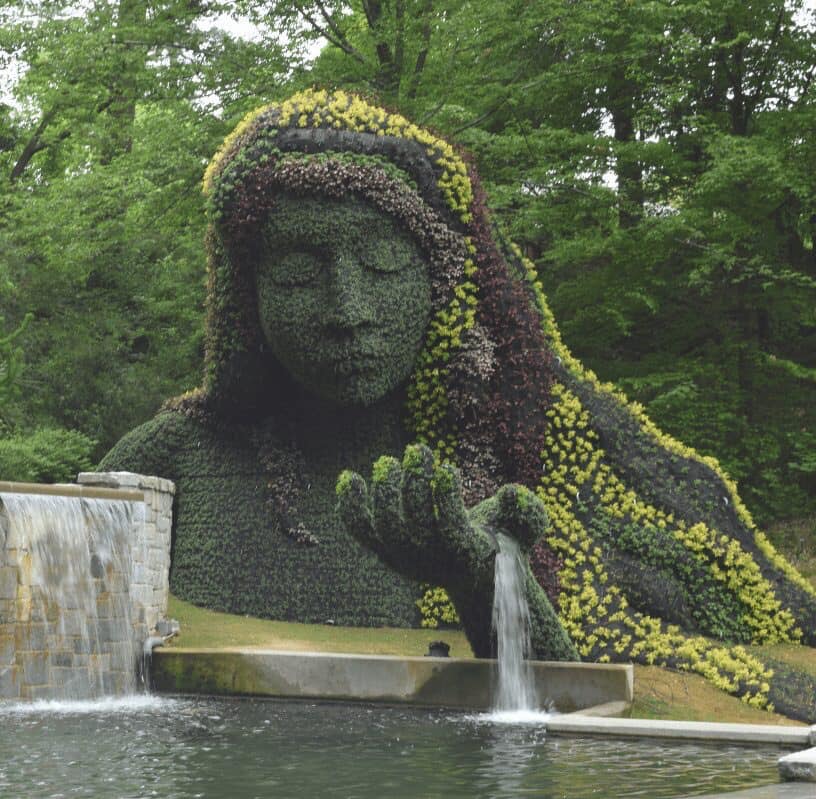
The idea of the Earth as an integrated whole, a living being, has a long tradition. The mythical Gaia was the primal Greek goddess personifying the Earth, the Greek version of “Mother Nature” (from Ge = Earth, and Aia = PIE grandmother), or the Earth Mother.
A mother goddess is a major goddess characterized as a mother or progenitor, either as an embodiment of motherhood and fertility or fulfilling the cosmological role of a creator- and/or destroyer-figure, typically associated the Earth, sky, and/or the life-giving bounties thereof in a maternal relation with humanity or other gods. When equated in this lattermost function with the earth or the natural world, such goddesses are sometimes referred to as the Mother Earth or Earth Mother, deity in various animistic or pantheistic religions.
The earth goddess is archetypally the wife or feminine counterpart of the Sky Father or Father Heaven, particularly in theologies derived from the Proto-Indo-European sphere (i.e. from Dheghom and Dyeus). In some polytheistic cultures, such as the Ancient Egyptian religion which narrates the cosmic egg myth, the sky is instead seen as the Heavenly Mother or Sky Mother as in Nut and Hathor, and the earth god is regarded as the male, paternal, and terrestrial partner, as in Osiris or Geb who hatched out of the maternal cosmic egg.
MATER NOSTRA: Although no Mother Goddess exists in Christianity, both the Catholic Church and the Orthodox Church revere Virgin Mary as the Mother of God, a rendering of Theotokos and Deipara since the Ecumenical Council of Ephesus in 431 AD, and disregard Protestant objections to Marian devotion. She is regarded as “Our Mother”, the Blessed Mother, or the Holy Mother as she gave birth to Jesus Christ, since Christians alike refer to themselves as “Brothers and Sisters in Christ”.
There is a Pater Noster but no equivalent Mater Nostra, however the Hail Mary and the Sub Tuum Praesidium have been popular forms of prayer and praise to Virgin Mary for many centuries. Some may perceive a parallel in calling Mary “Our Mother” and the Almighty Yahweh as “Our Father”. In contrast to the Pagan notion of a fertility goddess, Mary is both the Perpetual Virgin and the Mother of God at the same time, she is not considered the “Heavenly Mother” in reference to God the Father or the “Heavenly Father” as her consort.
GAIA: Pachamama is a goddess revered by the indigenous peoples of the Andes. In Inca mythology she is an “Earth Mother” type goddess, and a fertility goddess who presides over planting and harvesting, embodies the mountains, and causes earthquakes. She is also an ever-present and independent deity who has her own creative power to sustain life on Earth.
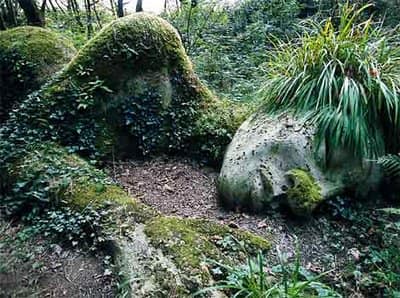
Her shrines are hallowed rocks, or the boles of legendary trees, and her artists envision her as an adult female bearing harvests of potatoes or coca leaves. The four cosmological Quechua principles – Water, Earth, Sun, and Moon, claim Pachamama as their prime origin.
After the Spanish colonization of the Americas, they converted the native populations of the region to Roman Catholicism. Due to religious syncretism, the figure of the Virgin Mary was associated with that of Pachamama for many of the indigenous peoples.
As Andean cultures formed modern nations, the figure of Pachamama was still believed to be benevolent, generous with her gifts, and a local name for Mother Nature. In the 21st century, many indigenous peoples in South America base environmental concerns in these ancient beliefs, saying that problems arise when people take too much from nature because they are taking too much from Pachama. – Wiki – Earth Day – 22 April.
Apr 22, 2025 11:26:31 pm