USHAS – ISHTAR – EASTER: As a moveable feast, the date of Easter is determined in each year through a calculation known as computus paschalis (Latin for ‘Easter computation’) – often simply Computus – or as paschalion particularly in the Eastern Orthodox Church. Easter is celebrated on the first Sunday after the Paschal full moon (a mathematical approximation of the first astronomical full moon, on or after 21 March – itself a fixed approximation of the March equinox).
Additionally, the church wished to eliminate dependencies on the Hebrew calendar, by deriving the date for Easter directly from the March equinox.
Easter commemorates the resurrection of Jesus, which Christians believe to have occurred on the third day (inclusive) after the beginning of Passover.
LITURGICAL EAST: East is the direction toward which the Earth rotates about its axis, and therefore the general direction from which the Sun appears to rise. The practice of praying towards the East is older than Christianity, but has been adopted by this religion as the Orient was thought of as containing mankind’s original home. Hence, Christian churches have been traditionally oriented towards the east. After some early exceptions, this tradition of having the altar on the liturgical east has become a part of the church orientation concept liturgical east and west.
Ad orientem, meaning “to the east” in Ecclesiastical Latin, is a phrase used to describe the eastward orientation of Christian prayer and Christian worship, comprising the preposition ad (toward) and oriens (rising, sunrise, east), participle of orior (to rise).
Since the time of the Early Church, the eastward direction of Christian prayer has carried a strong significance, attested by the writings of the Church Fathers. In the 2nd century, Syrian Christians hung a Christian cross on the eastern wall of their house, symbolizing “their souls facing God, talking with him, and sharing their spirituality with the Lord”.
Two centuries later, Saint Basil the Great declared that “facing the east to pray was among the oldest unwritten laws of the Church”. Nearly all Christian apologetic tracts published in the 7th century in the Syriac and Arabic languages explained that Christians prayed facing the east because “the Garden of Eden was planted in the east (Genesis 2:8) and … at the end of time, at the second coming, the Messiah would approach Jerusalem from the east.”
SHEKINAH: The eastward direction of prayer among early Christians is a custom inherited from the Jews. At the time of the formation of Christianity, Jews commonly prayed not only towards the Temple of Solomon, where the presence of the transcendent God (shekinah) [resided] in the Holy of Holies of the Temple, but also toward the east, although to what extent this practice was widespread is disputed.
After the Temple was destroyed, synagogical liturgy continued the practice of praying in that direction, “inseparably bound up with the messianic expectation of Israel.” Some rabbinic traditions encouraged Jews to construct synagogues with their entrances facing east, in imitation of the Temple of Jerusalem following its destruction, although this guideline was only sporadically implemented in practice.
ESSENES: It was the practice, Paul F. Bradshaw says, of the Jewish sects of the Essenes and the Therapeutae, for whom “the eastward prayer had acquired an eschatological dimension, the ‘fine bright day’ for which the Therapeutae prayed being apparently the messianic age and the Essene prayer towards the sun ‘as though beseeching him to rise’ being a petition for the coming of the priestly Messiah.” Eventually, a “process of mutual stimulus and disaffection” between Jews and early Christians seems to have brought about the end of Jewish prayer towards the east, and Christian prayer towards Jerusalem.
The Islamic practice of praying initially towards Jerusalem, as well as the concept of praying in a certain direction, is derived from the Jewish practice, which was ubiquitous among the Jewish communities of Syria, Palestine, Yathrib and Yemen. Additionally, the Christian custom of praying towards the east may have roots in the practice of the earliest Christians in Jerusalem of praying towards the Mount of Olives, to the east of the city, which they saw as the locus of key eschatological events and especially of the awaited Second Coming of Christ. Although the localization of the Second Coming on the Mount of Olives was abandoned after the destruction of Jerusalem in AD 70, the eastward direction of Christian prayer was retained and became general throughout Christendom.
Early Christians, who were largely persecuted, usually worshipped in house churches, and the Eucharist was never exposed to non-Christians. The church-hall, according to the evidence found at Dura-Europos, was oblong, with the people facing the eastern wall, where there was a platform where the table-altar of the Eucharist was offered by the presbyter/priest, who also apparently faced east. Images of biblical scenes and figures, including that of Christ, adorned the walls, including the eastern wall.
In the 2nd century, Syrian Christians indicated the direction in which to pray by placing a cross on the eastern wall of their house or church, a direction that symbolized “their souls facing God, talking with him, and sharing their spirituality with the Lord.” Believers turned towards it to pray at fixed prayer times, such as in the morning, evening and other parts of the day; this practice continues among some Christians today, along with the related custom of Christian families erecting their home altar or icon corner on the east wall of their dwellings.
AD ORIENTIS REGIONEM: Among the early Church Fathers, Tertullian used the equivalent phrase ad orientis regionem (to the region of the east) in his Apologeticus (A.D. 197). Clement of Alexandria (c. 150 – c. 215) says: “Since the dawn is an image of the day of birth, and from that point the light which has shone forth at first from the darkness increases, there has also dawned on those involved in darkness a day of the knowledge of truth.
In correspondence with the manner of the sun’s rising, prayers are made looking towards the sunrise in the east.” Origen (c. 185–253) says: “The fact that […] of all the quarters of the heavens, the east is the only direction we turn to when we pour out prayer, the reasons for this, I think, are not easily discovered by anyone.” Origen “firmly rejects the argument that if a house has a fine view in a different direction, one should face that way rather than towards the east.”
In the fourth century, Saint Basil the Great declared that one of the many beliefs and practices that Christians derived not from written teaching but by the tradition of the apostles was to turn to the East when praying. Using the phrase ad orientem, Augustine of Hippo mentioned the practice at the end of the fourth century.
Syriac and Arabic Christian apologetics of the 7th century explained that Christians prayed facing east because “the Garden of Eden was planted in the east (Genesis 2:8) and that at the end of time, at the second coming, the Messiah would approach Jerusalem from the east.” Saint John of Damascus taught that believers pray facing east because it “reminds Christians of their need to long for and strive for the paradise that God intended for them” and because “Christians affirm their faith in Christ as the Light of the world” by praying in the direction of sunrise.
SPIRITUAL LIGHT: In the eighth century, Saint John of Damascus, a Doctor of the Church, wrote:
It is not without reason or by chance that we worship towards the East. But seeing that we are composed of a visible and an invisible nature, that is to say, of a nature partly of spirit and partly of sense, we render also a twofold worship to the Creator; just as we sing both with our spirit and our bodily lips, and are baptized with both water and Spirit, and are united with the Lord in a twofold manner, being sharers in the Mysteries and in the grace of the Spirit. Since, therefore, God is spiritual light, and Christ is called in the Scriptures Sun of Righteousness and Dayspring, the East is the direction that must be assigned to His worship. For everything good must be assigned to Him from Whom every good thing arises. Indeed the divine David also says, Sing unto God, ye kingdoms of the earth: O sing praises unto the Lord: to Him that rideth upon the Heavens of heavens towards the East. Moreover the Scripture also says, And God planted a garden eastward in Eden; and there He put the man whom He had formed: and when he had transgressed His command He expelled him and made him to dwell over against the delights of Paradise, which clearly is the West. So, then, we worship God seeking and striving after our old fatherland. Moreover the tent of Moses had its veil and mercy seat towards the East. Also the tribe of Judah as the most precious pitched their camp on the East. Also in the celebrated temple of Solomon, the Gate of the Lord was placed eastward. Moreover Christ, when He hung on the Cross, had His face turned towards the West, and so we worship, striving after Him. And when He was received again into Heaven He was borne towards the East, and thus His apostles worship Him, and thus He will come again in the way in which they beheld Him going towards Heaven; as the Lord Himself said, As the lightning cometh out of the East and shineth even unto the West, so also shall the coming of the Son of Man be. So, then, in expectation of His coming we worship towards the East. But this tradition of the apostles is unwritten. For much that has been handed down to us by tradition is unwritten.
WORSHIPPERS OF THE SUN:Timothy I, an eighth-century patriarch of the Church of the East declared:
He [Christ] has taught us all the economy of the Christian religion: baptism, laws, ordinances, prayers, worship in the direction of the east, and the sacrifice that we offer. All these things He practiced in His person and taught us to practise ourselves.
Moses Bar-Kepha, a ninth-century bishop of the Syriac Orthodox Church called praying towards the east one of the mysteries of the Church.
Cardinal Joseph Ratzinger, who later became Pope Benedict XVI, described the eastward orientation as linked with the “cosmic sign of the rising sun which symbolizes the universality of God.” He also states in the same book (The Spirit of the Liturgy) that: ‘Despite all the variations in practice that have taken place far into the second millennium, one thing has remained clear for the whole of Christendom: praying toward the east is a tradition that goes back to the beginning. Moreover, it is a fundamental expression of the Christian synthesis of cosmos and history, of being rooted in the once-for-all events again.’
Traditionally churches are constructed so that during the celebration of the morning liturgy the priest and congregation face towards the rising sun, a symbol of Christ and the Second Coming.
The first Christians faced east when praying, likely an outgrowth of the ancient Jewish custom of praying in the direction of the Holy Temple in Jerusalem. Due to this established custom, Tertullian says some non-Christians thought they worshipped the sun. Origen says: “The fact that … of all the quarters of the heavens, the east is the only direction we turn to when we pour out prayer, the reasons for this, I think, are not easily discovered by anyone.”
The earliest Christian churches in Rome were all built with the entrance to the east, like the Jewish temple in Jerusalem
ISHTAR GATE: The Babylonian calendar began with the first new moon after the March equinox, the day after the return of the Sumerian goddess Inanna (later known as Ishtar) from the underworld, in the Akitu ceremony, with parades through the Ishtar Gate to the Eanna temple and the ritual re-enactment of the marriage to Tammuz, or Sumerian Dummuzi.
USHAS is a Vedic goddess of dawn in Hinduism. She repeatedly appears in the Rigvedic hymns, states David Kinsley, where she is “consistently identified with dawn, revealing herself with the daily coming of light to the world, driving away oppressive darkness, chasing away evil demons, rousing all life, setting all things in motion, sending everyone off to do their duties”. She is the life of all living creatures, the impeller of action and breath, the foe of chaos and confusion, the auspicious arouser of cosmic and moral order called the Ṛta in Hinduism.
EOSTRE is an Anglo-Saxon goddess mentioned by Bede in his 8th century work The Reckoning of Time. He wrote that pagan Anglo-Saxons had held feasts in her honour during the month named after her: Ēosturmōnaþ (April), and that this became the English name for the Paschal season: Easter.
In Northern Europe, Easter imagery often involves hares and rabbits. The first scholar to make a connection between the goddess Eostre and hares was Adolf Holtzmann in his book Deutsche Mythologie. Holtzmann wrote of the tradition, “the Easter Hare is inexplicable to me, but probably the hare was the sacred animal of Ostara.
In his late 19th-century study of the hare in folk custom and mythology, Charles J. Billson cited numerous incidents of folk customs involving hares around the Easter season in Northern Europe. Billson said that “whether there was a goddess named Ēostre, or not, and whatever connection the hare may have had with the ritual of Saxon or British worship, there are good grounds for believing that the sacredness of this animal reaches back into an age still more remote, where it is probably a very important part of the great Spring Festival of the prehistoric inhabitants of this island.” – Wiki –
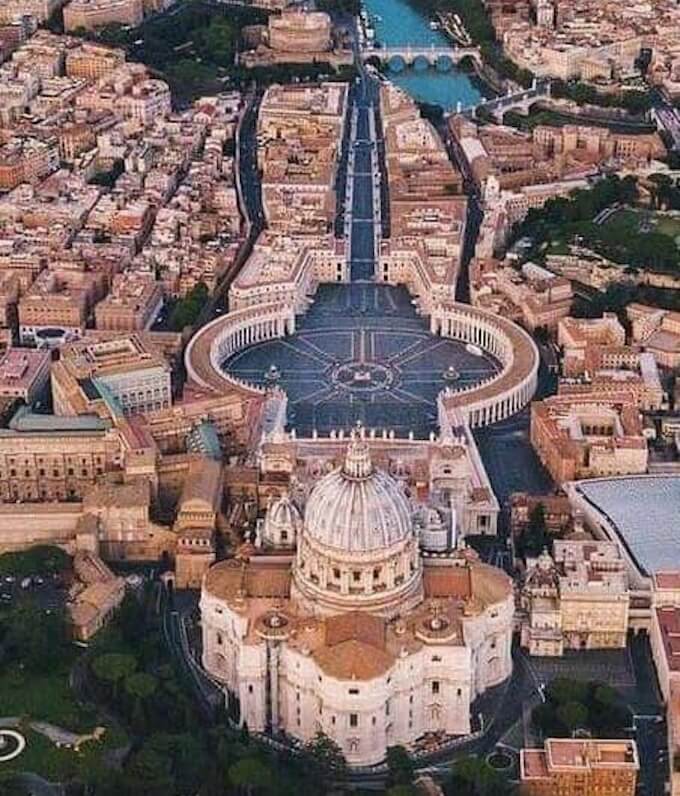
ST PETER’S BASILICA IN ROME FACES EAST TOWARDS THE SUNRISE ON THE EQUINOX:
Mar 22, 2025 10:44:09 pm