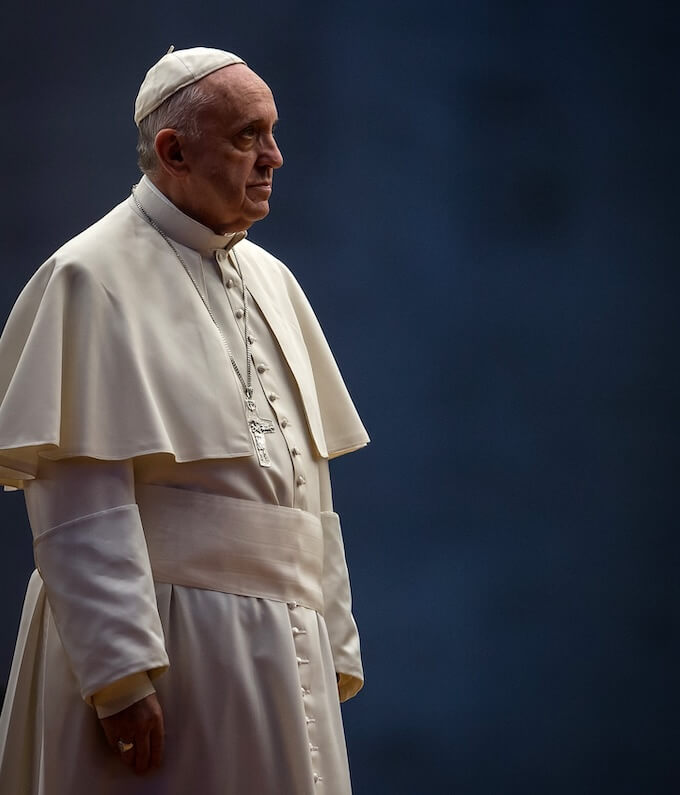
A RARE AND PRECIOUS LIGHT AMIDST THE OCEAN OF IGNORANT DARKNESS – URBI ET ORBI: I’m not Catholic, but there is something about Pope Francis that I appreciate very much. Even after spending 5 weeks in hospital with double pneumonia, he pulled through and delivered his annual Easter blessing from the Vatican. The Pope is 88. What I appreciate even more, is the fact that he didn’t allow Vice President JD Vance, a recent convert to Catholicism, to play him. JD took his family to Rome hoping to heal the rift he caused with his ignorant and bombastic understanding of scripture.
JD is as fake a Catholic as one gets. He only converted to help further his political ambitions, and I can promise you it was done at the behest of his mentor, Peter Thiel. Instead of meeting the Pope yesterday, JD had to settle for his second in command, who ended up giving him a lecture on compassion. Francis only met Vance for a few minutes earlier today, and yet Vance took to social media almost immediately after to fake flex. If the Pope calls you out, it’s like God calling you out, a big no no for any aspiring Catholic, never mind convict, I mean convert.
SPEAKING TRUTH TO POWER: Since Inauguration Day, as President Trump has sought to break the federal government, Christian leaders—tangling with Trump and, particularly, with his Vice-President, J. D. Vance—have wound up in a public dustup over the nature of charity. The dispute was brought into view on the Tuesday after the Inauguration, when, during a prayer service at the National Cathedral, Mariann Edgar Budde, the Episcopal bishop of Washington, D.C., asked Trump to “have mercy” on people made fearful by policies he had vowed to enact: the mass deportation of migrants and the curtailing of legal protections for gay and trans people.
The bishop’s challenge was a rare thing—a direct personal appeal to a figure whose office generally shields him from such attention. On immigration, her plea reflected something like a consensus position. Christian leaders, including Pope Francis and the National Council of Churches, which represents the views of more than three dozen Protestant and Orthodox groups, have denounced Trump’s rhetoric and policy proposals on immigration since he launched his first Presidential campaign, nearly a decade ago.
Soon after Bishop Budde challenged Trump, several Catholic bishops put out statements of a similar character. John Wester, of Santa Fe, affirmed the Christian imperative “to care for the resident and the stranger.” Mark Seitz, of El Paso, who is the chair of the U.S. bishops’ Committee on Migration, criticized the halting of refugee resettlement, the disregard for the asylum process, the questioning of birthright citizenship, and the championing of “a so-called ‘unifying American identity.’ ”
After the Administration announced the deportation raids, Seitz’s group joined the Catholic Health Association of the United States and Catholic Charities U.S.A. in a statement noting that “non-emergency immigration enforcement in schools, places of worship, social service agencies, healthcare facilities” and the like “would be contrary to the common good.
MIRROR MIRROR ON THE WALL: The statements were strikingly temperate, but they were too much for J. D. Vance. On CBS’s “Face the Nation,” the Vice-President, a convert to Catholicism, said, “I think that the U.S. Conference of Catholic Bishops needs to actually look in the mirror a little bit and recognize that when they receive over one hundred million dollars to help resettle illegal immigrants, are they worried about humanitarian concerns? Or are they actually worried about their bottom line?”
There followed a flurry of assertions and counter-assertions about Catholic social-service organizations and their budgets. The Church-funded Web site Our Sunday Visitor proposed that the hundred-million-dollar remark was a reference to $129.6 million that the bishops’ conference had received in 2023 for “refugee-related services,” and noted that the Conference reported spending $134.2 million on those services, or $4.6 million more than it received from the government.
Vance converted to Catholicism just five and a half years ago, but he is suddenly one of the most visible members of the Church in the United States. He was tutored by men from the Dominican order and he was baptized at St. Gertrude, a Dominican priory in Cincinnati. It was apt, then, that, three days after Dolan’s remarks, he went on TV prepared with talking points from the most famous Dominican of all: the thirteenth-century philosopher and theologian Thomas Aquinas. Speaking with Fox’s Sean Hannity, Vance suggested that efforts to provide charity to immigrants, which are favored by “the far left,” contradict Catholic teaching.
ORDO AMORIS: There’s “a very old school—and I think it’s a very Christian concept, by the way—that you love your family and then you love your neighbor, and then you love your community, and then you love your fellow-citizens in your own country, and then after that prioritize the rest of the world.” He was apparently referring to Aquinas’s idea of “ordered love,” or ordo amoris, set out in the “Summa Theologica”—an immense work, foundational to Catholic thought, that Aquinas left unfinished at his death, in 1274. And Vance seemed to be implying that Americans’ care for immigrants was at odds with it.
The Vice-President was immediately challenged on social media by Rory Stewart, the British academic, author, and former Conservative Party politician—and an Anglican—who called the remarks a “bizarre” and “pagan” inversion of the Gospel precept to love one another. Stewart added, “We should start worrying when politicians become theologians, assume to speak for Jesus, and tell us in which order to love.”
Vance doubled down: “Just google ‘ordo amoris,’ ” he wrote on X. “Does Rory really think his moral duties to his own children are the same as his duties to a stranger who lives thousands of miles away? Does anyone?”
All this prompted another spate of commentary, this time on the nature of charity and how it is performed in American society today. On a semiweekly podcast hosted by the conservative Web site the Dispatch, Bishop Seitz suggested that Vance was poorly informed about both Aquinas and the Church’s work.
THE GOOD SAMARITAN: “Certainly, no one would disagree that you have a primary responsibility to serve your most immediate family and then the community around you,” Seitz said, but he added that the Gospel, as in the story of the Good Samaritan, invites us to ask, “Who is my neighbor?”—thus challenging any notion that those responsibilities obviate obligations to help strangers in need.
On Monday, Pope Francis, in a letter to the U.S. bishops, urged Catholics, “and all men and women of good will, not to give in to narratives that discriminate against and cause unnecessary suffering to our migrant and refugee brothers and sisters.” In an apparent rejoinder to Vice-President Vance, the Pope observed that “the true ordo amoris that must be promoted” is the one represented by the Good Samaritan: “the love that builds a fraternity open to all, without exception.”
Cardinal McElroy, for his part, put the point more plainly during an interfaith service and rally on Sunday in San Diego—he appealed for an end to what he called a “war of fear and terror on migrants.” The day is coming when, as archbishop of Washington, he may need to speak with a like frankness in the capital, as Bishop Budde did, in an instance that already seems to belong to history. The New Yorker – By Paul Elie – February 11, 2025.
Apr 20, 2025 5:16:55 pm


