CATHOLIC INTEGRALISM: Someone was kind enough to point me in the right direction regarding my inquiries into Postliberal National Conservatism. The person suggested I focus on the Catholic Integralist Movement to find answers to my questions. I wish he hadn’t, as it has opened a whole new can of worms on the day of Pope Francis’ funeral. To really get to grips with the turn towards the hard right in places like Brazil, America, France, Italy, Hungary, Russia, and many other Western countries, understanding the Integralist Movement is key.
– In politics, integralism, integrationism or integrism is an interpretation of Catholic social teaching that argues the principle that the Catholic faith should be the basis of public law and public policy within civil society.
Catholic integralism is an interpretation of Catholic social teaching that argues for an authoritarian and anti-pluralist Catholic state, wherever the preponderance of Catholics within that society makes this possible; it was born in 19th-century Portugal, Spain, France, and Italy. It was a movement that sought to assert a Catholic underpinning to all social and political action and to minimize or eliminate any competing ideological actors, such as secular humanism and liberalism.
Integralism has, thus, also been used to describe non-Catholic religious movements, such as Protestant fundamentalism or Islamism. In the political and social history of the 19th and 20th centuries, the term integralism was often applied to traditionalist conservatism and similar political movements on the right wing of a political spectrum.
The term was used as an epithet to describe those who opposed the modernists, who had sought to create a synthesis between Christian theology and the liberal philosophy of secular modernity. Proponents of Catholic political integralism taught that all social and political action ought to be based on the Catholic Faith. They rejected the separation of church and state, arguing that Catholicism should be the proclaimed religion of the state.
COUNTER-REVOLUTION: Integralism arose in opposition to liberalism, which some Catholics saw as a “relentless and destructive ideology”. Catholic integralism does not support the creation of an autonomous “Catholic” State Church, or Erastianism (Gallicanism in French context). Rather, it supports subordinating the state to the moral principles of Catholicism.
Thus, it rejects separating morality from the state and favours Catholicism as the proclaimed religion of the state. However, Catholic integralism as a more consciously articulated doctrine came about as a reaction against the political and cultural changes that followed the Enlightenment and the French Revolution.
Contemporary discussions of integralism were renewed in 2014, focusing on criticism of liberalism and capitalism. In recent years, however, a “revived Catholic integralism” has been noted among the younger generation of Catholics. (Josh Hawley, Marco Rubio, Steve Bannon, Nick Fuentes, JD Vance, Candace Owens, George Farmer, Peter Thiel, Clarence Thomas, Samuel Alito, Ginni Thomas).
Integralism could be said to merely be the modern continuation of the traditional Catholic conception of Church–State relations elucidated by Pope Gelasius I and expounded upon throughout the centuries up to the Syllabus of Errors, which condemned the idea that the separation of Church and State is a moral good.
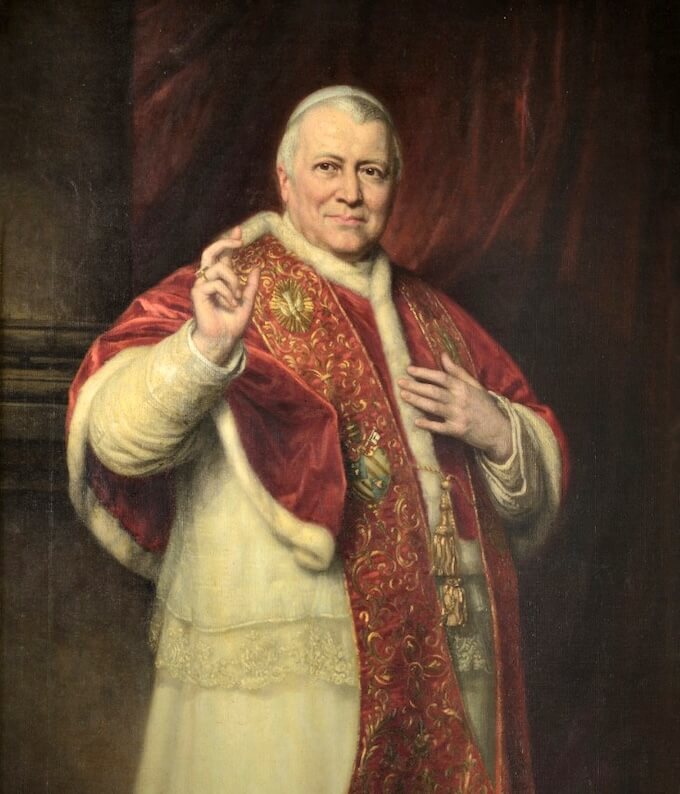
POPE PIUS IX: The 19th-century papacy challenged the growth of liberalism (with its doctrine of popular sovereignty) as well as new scientific and historical methods and theories (which were thought to threaten the special status of the Christian revelation). Pope Pius IX condemned a list of liberal and Enlightenment ideas in his Syllabus of Errors.
The Syllabus of Errors is the name given to an index document issued by the Holy See under Pope Pius IX on 8 December 1864 at the same time as his encyclical letter Quanta cura. It collected a total of 80 propositions that the Pope considered to be current errors or heresies, pairing the briefest headings with references to the various documents where the actual teachings are found.
Pope Pius IX (Italian: Pio IX; born Giovanni Maria Mastai-Ferretti; 13 May 1792 – 7 February 1878) was head of the Catholic Church from 1846 to 1878. His reign of nearly 32 years is the longest verified of any pope in history. If including unverified reigns, his reign was second to that of Peter the Apostle. He was notable for convoking the First Vatican Council in 1868 and for permanently losing control of the Papal States in 1870 to the Kingdom of Italy. Thereafter, he refused to leave Vatican City, declaring himself a “prisoner in the Vatican”.
CATHOLIFASCISM: The Southern Poverty Law Center uses the term “integrism” to refer to “radical traditional Catholics” who reject the Second Vatican Council. SPLC describes them as antisemitic and “extremely conservative” regarding women, and also notes that some claim recent popes are illegitimate.
Critics and opponents of integralism, such as George Weigel, argue that the movement can be associated with fascism. Supporters of integralism argue that it is a mistake to associate the movement with fascism, stating that it developed before fascism, and that collaboration between fascist and integralist groups is overstated. John Zmirak criticizes contemporary Catholic integralists as enemies of “religious liberty”. – Wiki –
POPE PIUS IX.
Apr 26, 2025 3:02:33 pm


