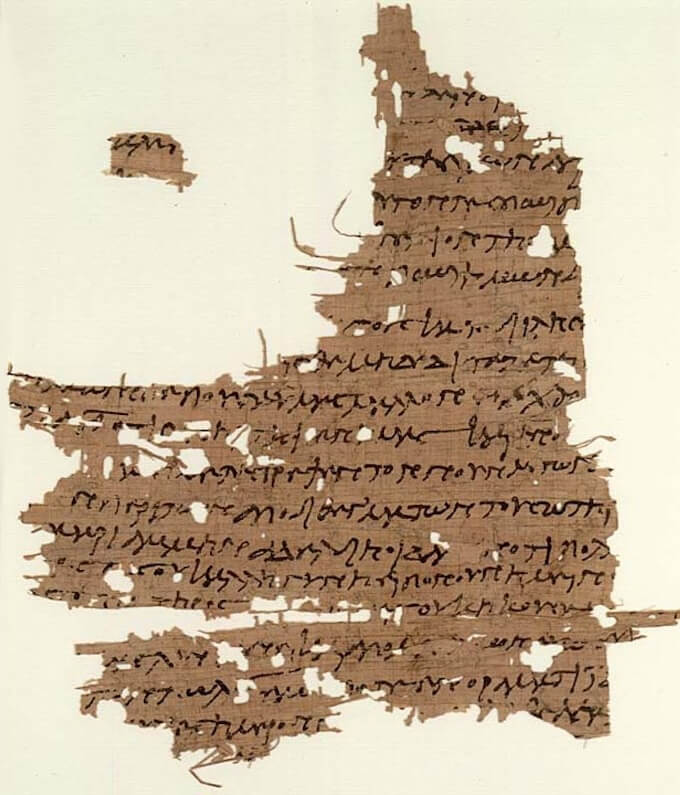
The most complete text of the Gospel of Mary is contained in the Berlin Codex, but even so, it is missing six manuscript pages at the beginning of the document and four manuscript pages in the middle. As such, the narrative begins in the middle of a scene, leaving the setting and circumstances unclear.
As the narrative opens, Jesus is engaged in dialogue with his disciples, answering their questions on the nature of matter and the nature of sin. At the end of the discussion, Jesus departs, leaving the disciples distraught and anxious. According to the story, Mary speaks up with words of comfort and encouragement.
Then Peter asks Mary to share with them any special teaching she received from the Jesus, “Peter said to Mary, ‘Sister, we know that the Savior loved you more than the rest of the women. Tell us the words of the Savior which you remember – which you know (but) we do not, nor have we heard them.’’
Mary responds to Peter’s request by recounting a conversation she had with Christ about visions. (Mary) said, “I saw the Lord in a vision and I said to him, ‘Lord, I saw you today in a vision.’” He answered and said to me: “Blessed are you, that you did not waver at the sight of me. For where the mind is, there is the treasure.”
When Mary had said this, she fell silent, since it was to this point that the Savior had spoken with her.
But Andrew answered and said to the brethren, Say what you wish to say about what she has said. I at least do not believe that the Savior said this. For certainly these teachings are strange ideas.
Peter answered and spoke concerning these same things. He questioned them about the Savior: Did He really speak privately with a woman and not openly to us? Are we to turn about and all listen to her? Did He prefer her to us?
Then Mary wept and said to Peter, My brother Peter, what do you think? Do you think that I have thought this up myself in my heart, or that I am lying about the Savior?
Levi answered and said to Peter, Peter you have always been hot tempered.
Now I see you contending against the woman like the adversaries. But if the Savior made her worthy, who are you indeed to reject her? Surely the Savior knows her very well.
That is why He loved her more than us. Rather let us be ashamed and put on the perfect Man, and separate as He commanded us and preach the gospel, not laying down any other rule or other law beyond what the Savior said.
And when they heard this they began to go forth to proclaim and to preach.
CHURCH AUTHORITY: Karen King considers the work to provide – an intriguing glimpse into a kind of Christianity lost for almost fifteen hundred years…[it] presents a radical interpretation of Jesus’ teachings as a path to inner spiritual knowledge; it rejects His suffering and death as the path to eternal life; it exposes the erroneous view that Mary of Magdala was a prostitute for what it is – a piece of theological fiction; it presents the most straightforward and convincing argument in any early Christian writing for the legitimacy of women’s leadership; it offers a sharp critique of illegitimate power and a utopian vision of spiritual perfection; it challenges our rather romantic views about the harmony and unanimity of the first Christians; and it asks us to rethink the basis for church authority.
King concludes that “both the content and the text’s structure lead the reader inward toward the identity, power and freedom of the true self, the soul set free from the Powers of Matter and the fear of death”. “The Gospel of Mary is about inter-Christian controversies, the reliability of the disciples’ witness, the validity of teachings given to the disciples through post-resurrection revelation and vision, and the leadership of women.”
King also sees evidence for tensions within second-century Christianity, reflected in “the confrontation of Mary with Peter, [which is] a scenario also found in The Gospel of Thomas, Pistis Sophia, and the Coptic Gospel of the Egyptians. Peter and Andrew represent orthodox positions which deny the validity of esoteric revelation and reject the authority of women to teach.”
CANON LAW: – In the liturgical traditions of the Catholic Church, the term ordination refers to the means by which a person is included in one of the holy orders of bishops, priests, or deacons. The teaching of the Catholic Church on ordination, as expressed in the 1983 Code of Canon Law, the Catechism of the Catholic Church, and Ordinatio sacerdotalis (an apostolic letter), is that only a Catholic male validly receives ordination (ex opere operato), and “that the Church has no authority whatsoever to confer priestly ordination on women and that this judgment is to be definitively held by all the Church’s faithful.”
In other words, the male priesthood is not considered by the church a matter of policy but an unalterable requirement of God. As with priests and bishops, the church ordains only men as deacons.
While the church believes Christians have the right to receive the sacraments, the church does not believe in a right to ordination. The church believes the sacraments work ex opere operato as manifestations of Jesus’ actions and words during his life, and that according to dogma Jesus only chose certain men as apostles. The church teaches that a woman’s impediment to ordination is diriment, of divine law, public, absolute, and permanent because Jesus instituted ordination by ordaining the twelve apostles, since holy orders is a manifestation of Jesus’ calling of the apostles.
A CLOSED DOOR: On May 22, 1994, John Paul II promulgated Ordinatio sacerdotalis, where he states that the Church cannot confer priestly ordination on women: “Wherefore, in order that all doubt may be removed regarding a matter of great importance, a matter which pertains to the Church’s divine constitution itself, in virtue of my ministry of confirming the brethren, I declare that the Church has no authority whatsoever to confer priestly ordination on women and that this judgment is to be definitively held by all the Church’s faithful.”
Pope Francis said in a 2013 interview that regarding women’s priestly ordination, “with reference to the ordination of women, the Church has spoken and says, ‘No.’ John Paul II said it, but with a definitive formulation. That is closed, that door.” He later expanded on this in a November 2016 informal statement on the return flight from his papal visit to Sweden to commemorate the Reformation: “On the ordination of women in the Catholic Church, the final word is clear, it was said by St. John Paul II and this remains.” – Wiki –
Apr 26, 2025 10:45:47 pm