May 22, 2025 2:52:23 pm
What is the hidden provision in the bill? The sweeping budget bill that passed the US House on Thursday has a hidden provision- it seeks to limit the ability of courts—including the US Supreme Court—from enforcing their orders, reports Newsweek.
“No court of the United States may use appropriated funds to enforce a contempt citation for failure to comply with an injunction or temporary restraining order if no security was given when the injunction or order was issued,” the provision in the bill, which is more than 1,000 pages long, says.
The provision would bar courts from enforcing contempt citations for breaches of injunctions or temporary restraining orders—key tools often used to limit actions by President Donald Trump’s administration—unless the plaintiffs have posted a bond, which is uncommon in lawsuits against the government. If passed, Erwin Chemerinsky, dean of the University of California Berkeley School of Law, described it in a Just Security article as a “stunning” limitation on the authority of federal courts.
“The Supreme Court has long recognized that the contempt power is integral to the authority of the federal courts,” he wrote. “Without the ability to enforce judicial orders, they are rendered mere advisory opinions which parties are free to disregard.”
Why is this significant? Dozens of lawsuits have been filed since Trump returned to office, challenging his executive orders and actions taken by his administration. Judges have partially or fully blocked the president in at least 82 cases, according to a tally by The Associated Press. The administration has been pushing back against court rulings it doesn’t like, with the president lashing out at judges who rule against him and seeking an end to nationwide injunctions.
According to legal scholar Erwin Chemerinsky, a provision in the House bill would render such court orders “completely unenforceable.”
“The bill is truly sweeping in scope,” Chemerinsky said. “It would apply to every temporary restraining order, preliminary injunction, and even permanent injunction ever issued.”
Robert Reich, a former Labor Secretary and a professor of public policy at University of California Berkeley, wrote in a Substack post that the “hidden” provision “makes Trump King.” He wrote: “No congress and no court could stop him. Even if a future Congress were to try to stop him, it could not do so without the power of the courts to enforce their hearings, investigations, subpoenas, and laws. What can you do? To begin with, call your members of Congress and tell them not to pass Trump’s One Big Ugly Bill.” Economic Times 22 May.
RAZOR-THIN: House Republicans have successfully passed Donald Trump’s multi-trillion-dollar ‘big beautiful’ tax bill in a major win for the president. Its passage 215-214 is a major milestone for the White House and Republicans in Congress who have spent the entirety of the new administration crafting the measure’s specifics.
There were two GOP no’s on the vote, Warren Davidson, R-Ohio, and Thomas Massie, R-Ky. Speaker Mike Jonson, R-La., worked closely with Trump on formulating the bill that features many of the president’s campaign promises, and getting the rest of the GOP rebels across the finish line.
If just three Republicans opposed the bill it would have failed with their razor-thin majority. Trump threatened that Republicans who didn’t get behind the package would be ‘knocked out’ in the upcoming 2026 midterms elections, considering any dissent ‘the ultimate betrayal.’
This close relationship between the president and speaker gave Johnson leverage over several unruly Republicans who threatened to vote against the bill. The bill accounts for trillions of dollars in tax cuts and enshrines Trump’s signature slashes in 2017.
House Majority Leader Steve Scalise, R-La., called Trump’s 2017 law ‘revolutionary’ on Thursday, adding that the new bill ‘is even more revolutionary.’ The package also provides for $350 billion to go to MAGA projects including to Trump’s new ‘Golden Dome’ missile defense system and his mass deportation policies.
To fund the massive loss in federal revenue, Congress has decided to make deep cuts to social programs and add work requirements to Medicaid.
ONE VOTE ENSHRINES CORRUPTION: On Tuesday, Trump traveled to Capitol Hill to warn Republicans not to ‘f*** around with Medicaid’ benefits, which are popular in many swing districts, and issued his final warning to holdouts. It is also estimated to add about $3 trillion to the national deficit – which terrified some of the far-right conservative voting block.
Democrats feverishly pushed back against the bill which contains steep spending cuts for social programs. However, the liberal members of Congress may as well be bystanders in this process, as the mechanism the GOP leadership is using to get the massive package cobbled together, reconciliation, almost ensures that no Democrat votes are needed.
Though the rules managing reconciliation are strict and only certain bills can employ the tool, it means that the ‘big, beautiful bill’ will need a simple majority in the Senate (51 votes) to send the measure to Trump’s desk for signing.
Typically legislation needs at least 60 votes to pass out of the Senate, however, reconciliation brings that threshold down. Given that Republicans hold 53 seats in the Senate, the GOP can theoretically pass the bill without Democratic support.
Trump previously used reconciliation in his first term to pass his 2017 tax cuts, which are being codified into law in this current package.
House Republicans also added language to the ‘big, beautiful bill,’ to increase the federal debt limit by trillions. The inclusion of the increase will help avoid a default on the debt this year, when a previous debt limit agreement is set to expire. Including it in reconciliation also enables Republicans to avoid negotiating with Democrats over the size of the increase. By JON MICHAEL RAASCH.
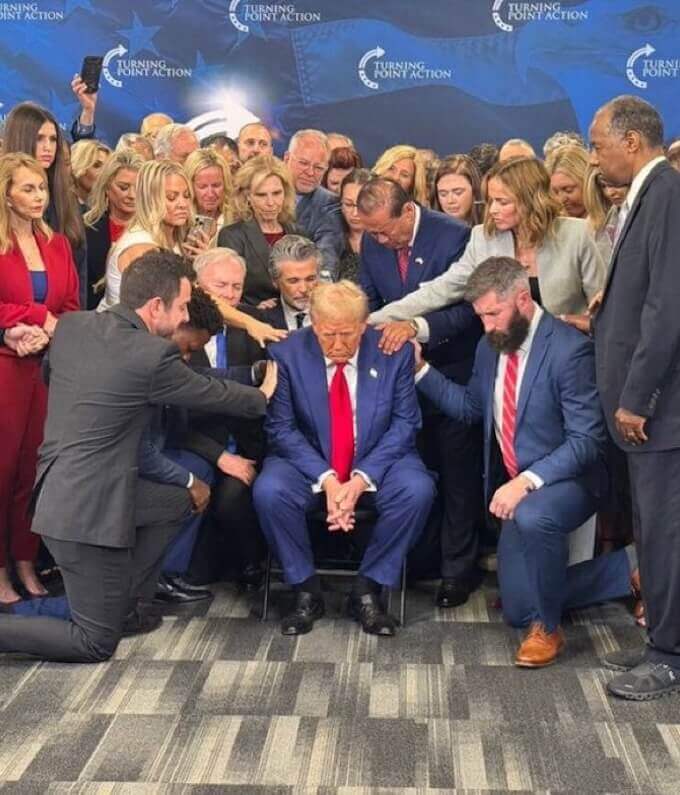
PROSPERITY THEOLOGY (sometimes referred to as the prosperity gospel, the health and wealth gospel, the gospel of success, seed-faith gospel, Faith movement, or Word-Faith movement) is a belief among some Charismatic Christians that financial blessing and physical well-being are always the will of God for them, and that faith, positive scriptural confession, and giving to charitable and religious causes will increase one’s material wealth. Material and especially financial success is seen as an evidence of divine grace or favor and blessings. – Wiki