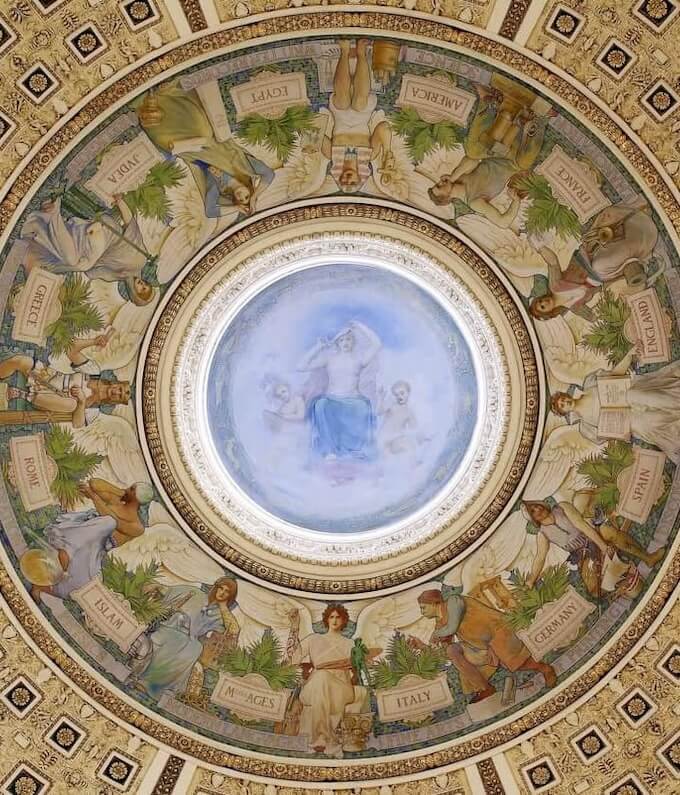
“I am all that has been and is and shall be, and no mortal has ever lifted my mantle.” The Evolution of Civilization is the centerpiece of the dome in the main reading room of the Thomas Jefferson Building, Washington DC. Twelve figures, six men and six woman embody the evolution of western culture, and in particular, American culture.
Starting with Egypt (written records) as the source, then Judea (religion), Greece (philosophy), Rome (administration), Islam (physics), the Middle Ages (modern languages), Italy (fine arts), Germany (art of printing), Spain (discovery), England (literature), France (emancipation), and ending with America (science).
Each epoch or culture is associated with a particular contribution made to the evolution of civilization. The focus is solely on the West, as cultures in India, China, Mesopotamia, and Mesoamerica were highly advanced and civilized. The inclusion of Egypt and Islam is refreshing considering that these culture are not normally associated with western civilization. The twelve figures mirror the constellations of the zodiac, but instead of revolving around the sun, they revolve around the ninth and most important muse of inspiration, the goddes Isis, muse of muses.
The twelve figures are arranged in such a manner that the six women form an equilateral triangle to mirror the equilateral triangle formed by the six men. Together these two triangles create a perfectly balanced hexagram of masculine and feminine energies.
The figure at the center of the dome is described as a beautiful woman who embodies – Human Understanding lifts the veil of ignorance and looks forward to intellectual progress – The cherub next to her holds the Book of Wisdom and Knowledge.
A statue of a veiled Isis was found at Sais in ancient Egypt accompanied by the sentence mentioned in the intro to this post. The Veiled Isis is a metaphor and allegorical artistic motif that represents the inaccessibility of natures secrets. Illustrations of Isis with her veil being lifted were popular at the end of the 17th century as allegorical representations of Enlightenment progress uncovering nature’s mysteries.
A different interpretation emerged during the late 18th century that focused on the unveiling as a metaphor for the revelation of awe-inspiring truths beyond scientific discovery. Both Romanticism and the Symbolist movement came about as resistance against the Age of Reason and the removal of the mysterious and more spiritual aspect of nature.
In their drive to eliminate the superstitious beliefs responsible for the death of thousands of innocent women, scientists, philosophers, mystics, and heretics at the hands of religious fundamentalists, Enlightenment thinkers unfortunately went too far. They put all their eggs in the reason basket, and in the process sacrificed the more mysterious aspects of consciousness.
This lack of reverence has had devastating consequences for the environment, and at the same time exposed the shortcomings of intelligence as promulgated by reason. Science lost its soul. It is the separation of science and spirituality that lies at the root of humanities existential crisis. Reason alone is not enough, a concept reinforced by the divine inspiration embodied by the nine muses.
What is needed is the resacralization of nature and science. A wise person understands that the more they know, the less they know. Knowledge is learning, and wisdom is letting go of everything you think you know. To believe we have solved all of life’s mysteries is the epitome of arrogance. Intellectual progress without heart is cold and meaningless. I’d rather be compassionate than clever. I’d rather feel connected than isolated. Religion is not the answer, but neither is atheism. Sacred science is.
Nov 03, 2024 12:06:37 am
