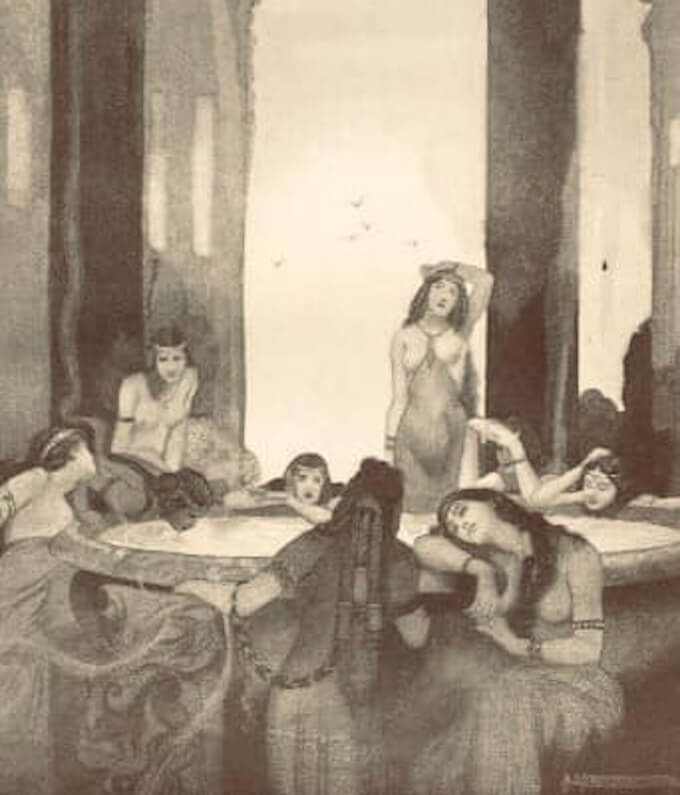
PEREDUR OR PARZIVAL? The nine sisters, maidens, virgin priestesses, supernatural women, play a very important role in the Grail mythology. Said to be benevolent enchantresses led by the Morgan le Fay, they are most closely connected to the magical Isle of Apples, Avalon. Morgan was a learned mathematician that also taught astronomy. This detail is important in relation to the alignment of sacred sites along Ley-lines. Most if not all of these megaliths were built according to astronomical principles based on the cycles of time, the movements of the stars and planets.
Morgan is also connected to the Lady of the Lake and water in general. Sacred wells played an important role in pre Christian cultures, as do the baptismal font in churches. The name Morgan can be linked to a few different streams, St Muirgen being one of the most astonishing. She is a Christian Irish shapeshifting female Saint associated with the sea and mermaids. Called sea-born, sea-wanderer, her feast is celebrated on 27 January.
The University of Notre Dame founded in 1842 is also called, Notre Dame du Lac, Our Lady of the Lake. A fusion of Arthurian legend and French Catholicism, directly connecting Mother Mary to the Lady of the Lake. Mary as already mentioned in a previous post is also called Stella Maris, Star of the Sea.
In all honesty, I had never heard of Peredur, a Welsh version of the original Grail hero, Parzival. Mirrored on Chrétien de Troyes story, Peredur son of Efrawg, part of the Mabinogion legends, omit one major detail from the story, the actual Grail itself. The Grail is replaced by a severed head on a platter and the quest becomes one of vengeance not enlightenment. Peredur is shown the head in what can be taken as the Grail Castle by the ‘Fisher King’. He does not enquire about this strange object and continues on his journey. Determined to join the Knights of the Round Table, Peredur sets out to prove himself to Arthur.
On his travels he comes across a castle that is under constant attack from a group of nine evil witches. He defends the castle and ends up staying with the nine women and learning all of their secrets. On his return he discovers that the head was in fact that of his cousin, and encouraged by his foster-sister who blames witchcraft for his death, attacks the witches. After trying to reason with the head witch, he ends up killing her.
King Arthur and the rest of the knights destroy the magical cauldron the nine maidens protect, and slay all of the remaining sisters, priestesses, witches, freeing the kingdom of the ‘great scourge of witchcraft’. Peredur becomes the last keeper of their magic secrets. This story helps make sense of why Arthur did not protect the Lady of the Lake when Sir Bailin beheaded her. As the legends evolved, all mention of druids and enchantresses using magic were replaced by Christian ideals of chastity, purity, and supposed holiness.
Scholars have pointed out how this story could be an echo of an otherwise unrecorded extermination of indigenous Celtic Pagan cults by Christians during the 5th and 6th centuries.
One can clearly see how Peredur, the ideal Knight, a man, becomes the last keeper of the secrets held for countless generations by women. It shows the movement from priestess to priest, matriarchy to patriarchy. Women were, and in many cases still are, forbidden from joining the priesthood.
Magical cauldrons play a huge role in Celtic mythology as does severed heads, in particular that of Bran the Blessed. Bran and the Fisher King also share many similarities. The Knights Templar were accused of worshipping a bearded head called Baphomet, a possible misspelling of Mahomet, Muhammad.
The Grail Cup was potentially based on the Magical Cauldron found in Celtic mythology. In some instances it could resurrect the dead, but was mostly connected to Awen, the gift of poetic inspiration. The potion found in the cauldron was also said to impart wisdom and knowledge, yet only three drops, as the rest was poisonous. It is impossible to escape the inevitable role sacred medicine plants played in the transformation of consciousness, similar to Kykeon of the Eleusinian Mysteries.
The magical potion was replaced by the blood and body of Christ, robbing people of the wisdom, insight, and inspiration gained from eating from the tree of knowledge.

