The March equinox or northward equinox is the equinox on the Earth when the subsolar point appears to leave the Southern Hemisphere and cross the celestial equator, heading northward as seen from Earth. The March equinox is known as the vernal equinox (or spring equinox) in the Northern Hemisphere and as the autumnal equinox (or fall equinox) in the Southern Hemisphere.
In its apparent motion on the day of an equinox, the Sun’s disk crosses the Earth’s horizon directly to the east at sunrise; and again, some 12 hours later, directly to the west at sunset. The March equinox, like all equinoxes, is characterized by having an almost exactly equal amount of daylight and night across most latitudes on Earth.
As the sun sets on the day of the spring equinox in March and the shadows fall across the Pyramid of Kukulcan in the ancient Maya city of Chichen Itza, the mysterious shape of a serpent ripples across the stone. This is the symbol of Kukulcan, the feathered serpent god, returning to earth.
Ancient temple builders aligned the pyramid so precisely that it catches the rays of the setting sun on the days of the spring and fall equinoxes in March and September. Triangles of light and shadow appear along the side of the north staircase forming the shape of a snake, which merges with the head of a stone snake at the foot of the building. The illusion is created of a gigantic serpent slithering down from the heavens and across the ground towards the Sacred Cenote.
The snake symbolizes Kukulcan (also known as Quetzalcoatl in central Mexico), the feathered serpent god, who returns to earth to give hope to his followers and it also heralds the spring planting and fall harvest seasons for the Maya, thus acting as a solar calendar.
The light and shadow snake is visible the day before and after the equinox, cloud cover permitting. – Royal resorts –
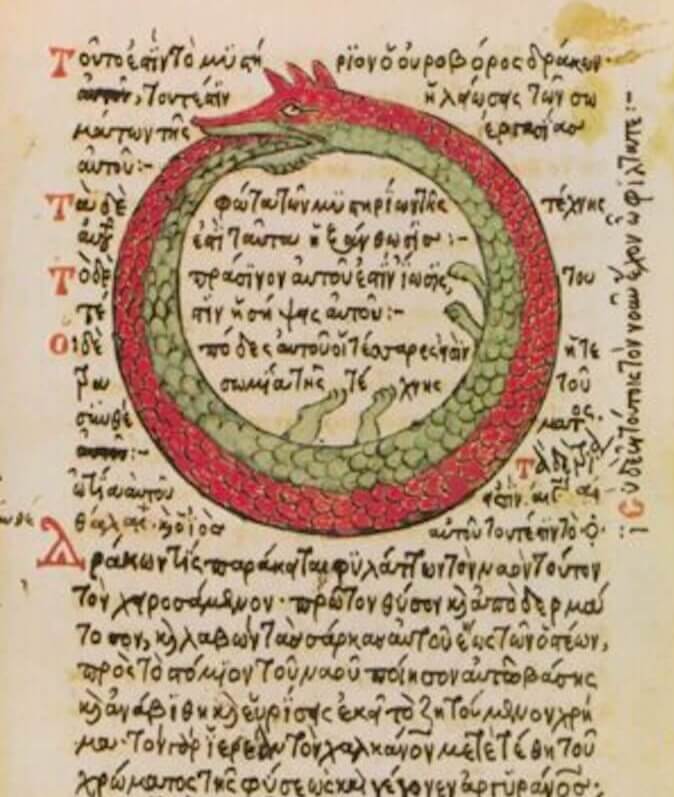
Chichen Itza, Mexico. Modern Ouroboros sculpture Linda Lee – Canberra, Australia. 1479 Ouroboros drawing.
Mar 23, 2025 12:59:04 pm


