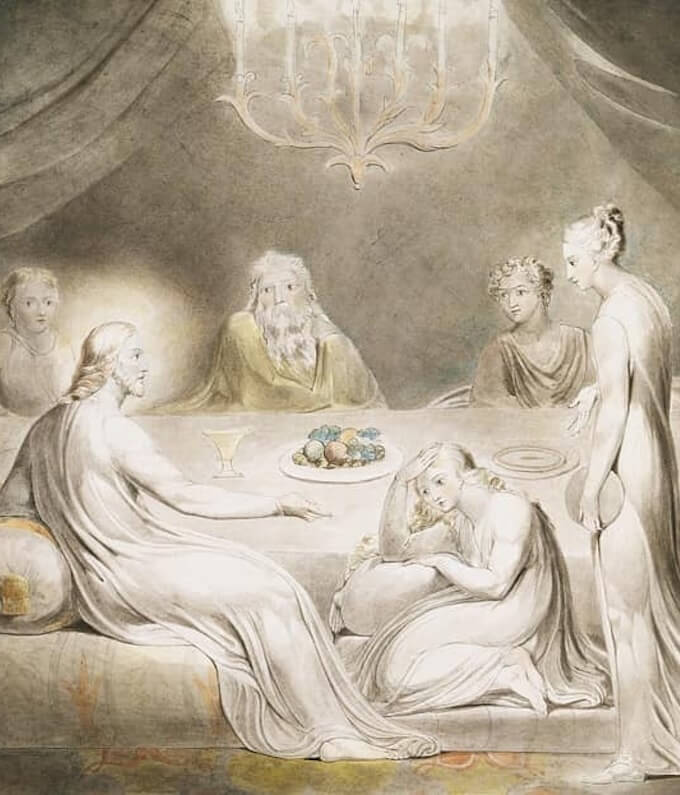
If it wasn’t for the propaganda found in the Gospel of Luke, Mary Magdalene would not have been branded as a fallen woman by the church fathers. More than anyone, Saint Luke is to blame for blackening Mary’s name. The featured painting by William Blake 1757-1827, is titled –
‘Christ in the House of Martha and Mary But Martha was Cumbered About Much Serving’.
Blake created the image based on Luke 10: 38-42. Now what makes the mention of Mary and Martha relevant, is that Luke obviously knew about them, yet chose to distort the original anointment scene of Jesus by Mary of Bethany found in the Gospel of John. Instead of writing that the anointment took place in the house of Lazarus, brother of Mary and Martha, Luke doesn’t name a town or person, just some random Pharisee. But what he does say is that an unnamed woman, who was also a sinner, anointed Jesus. Luke 7: 36-39.
This man, if he were a prophet, would have known who and what manner of woman this is that toucheth him: for she is a sinner.
To compound matters, Luke then decides to make the following statement at the start of chapter 8, only a dozen verses after calling the woman a sinner.
Luke 8: 2 And certain women, which had been healed of evil spirits and infirmities, Mary called Magdalene, out of whom went seven devils.
In the sixth century Pope Gregory took the initiative and used Luke’s words to brand Mary Magdalene a fallen woman and prostitute. Mary Magdalene, Mary of Bethany, and the sinful woman were conflated into one. It was only in the 1960’s that the Catholic Church separated the Marys into Mary Magdalene and Mary of Bethany. This might look like a good thing, yet it isn’t, all that happened was the further distancing of Mary from Jesus.
Luke excels at creating as much space between the Marys and Jesus as possible. He doesn’t mention Mary as standing at the foot of the cross, rather just some random women looking on from a distance. Luke 23: 49. He doesn’t mention Mary as the first to meet him at the empty tomb, choosing to say that two male disciples on the road to Emmaus were the first to see Jesus after the Resurrection. Luke 24: 10/13.
Luke wrote the Gospel of Luke and the Book of Acts, 27.5% of the New Testament. Luke wasn’t a disciple of Jesus, he was a follower of Saint Paul the Imposter. Mary Magdalene plays an enormous role in the fourth and final Gospel of John, yet in the very next book, Acts of the Apostles, Mary Magdalene isn’t mentioned at all, not even once. In fact Mary never features again in the New Testament. Not Mary Magdalene or Mary of Bethany, they just vanish.
Instead of separating the Marys in the 1960s, the Church should have chucked Luke’s version of the anointment in the bin, where it belongs. Did Paul influence his student Luke’s version of events? Keep in mind that Paul never met Jesus, not even once. The first time he met any of the disciples was three years after the Resurrection. Paul as Saul used to hunt the early Christians, he could even have hunted Mary and her family. Apart from Saint Peter, was Mary his biggest adversary during the early years of the church? Paul despised women and repeatedly states that they should have no part in leading or teaching in the church. They weren’t even allowed to ask questions.