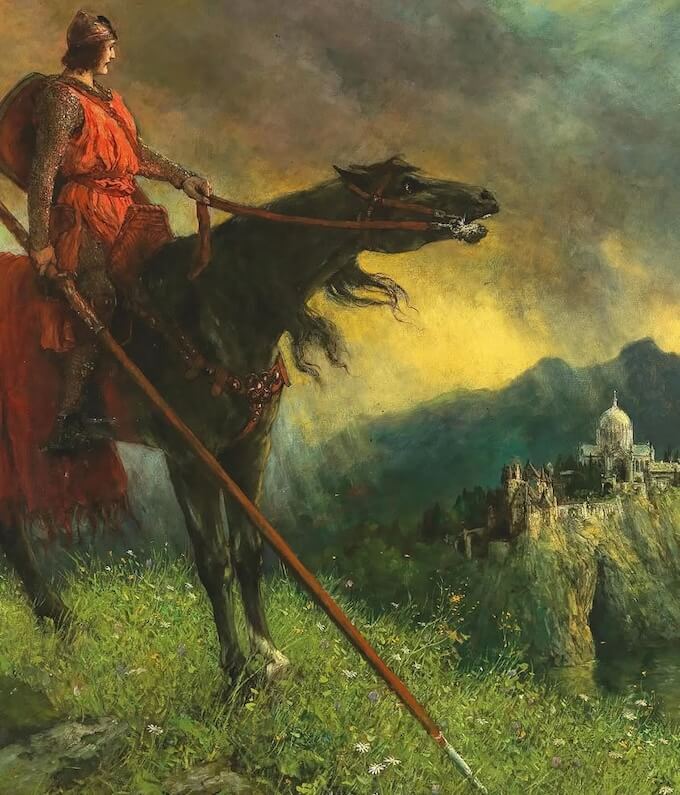
The French poet Chrétien de Troyes composed Perceval, his fifth and final poem between 1182-1190. He was the first to introduce the not so holy grail that was unrelated to the Cup of Christ. It resembled a platter or dish more than a cup. It was the French poet Robert de Boron that added the Christian aspect to the legend in his poem Joseph d’Arimathie.
Scholars believe he wrote it as part of a trilogy, Merlin, Joseph, and Perceval, sometime after the discovery of King Arthur and Queen Guinevere’s grave at Glastonbury Abbey in 1191. Robert de Boron started the legend that Joseph had brought the cup used at the Last Supper and that caught the blood of Jesus on the crucifix to Britain in the 1st century.
The English kings were fighting the Welsh at the time and desperately needed proof that the prophesied return of Arthur was impossible because of the discovery of his skeleton and grave. The monks in Glastonbury needed pilgrims to finance the rebuilding of the Abbey which had burned down in 1184. They also connected Glastonbury to Avalon, the sacred Isle of Apples mentioned in Geoffrey of Monmouth’s History of the Kings of Britain written between 1130-1135. Geoffrey introduced the world to Uther Pendragon, the prophet Merlin, and King Arthur. It was Robert de Boron that changed the narrative regarding Merlin by claiming he was the offspring of a demon and virgin nun, the Antichrist.
Because Chrétien of Troyes left the Grail legend of Perceval unfinished, numerous authors and poets took it upon themselves to complete the tale. In Chrétien’s story Percival doesn’t find the Grail but he does introduce many of the key elements; the grail castle, the Fisher King, the grail, and of course the search for the grail.
Chrétien was also the first to introduce Lancelot in the poem, Knight of the Cart. Now what makes the story of Lancelot so intriguing, is that Chrétien says in the preface that he was given the material for the illicit affair between Lancelot and Guinevere by Countess Marie of Champagne. Marie was renowned for her literary patronage of authors and poets, she had an extensive library. Chrétien served in her court sometime between 1160-1172. He wrote the first of his poems, Erec and Enide in 1170, followed by Cligés, Yvain, Lancelot between 1175-1180, and finally Perceval between 1182-1190.
The Golden Myth regarding Eleanor of Aquitaine and her role in supporting the troubadours and even providing the overall arc of the Grail legends gains more credence if we consider the role of her daughter Marie of Champagne. The legends started in the period that Eleanor spent in Aquitaine between 1168-1173 before her imprisonment by her husband King Henry for treason. Eleanor had access to the legends of Arthur from her time spent in England. The very unusual aspect to the poems written by Chretien was his use of the idea of romantic love between couples, and even in marriage, a strange concept at the time.
Marriages were arranged from an early age and love was less important than titles or land gained from these manufactured unions. One of the inspirations for the romantic and sexual attraction found in the poems came from the Song of Songs written by King Solomon. Instead of viewing the Songs as a relationship between God and the Church, it was taken literally, passionate love between two people. This was coupled with chivalry and the proper way to treat a lady and win her affections. Women weren’t merely viewed as fulfilling a role as either mother or mistress but was elevated, respected and honored.
If we consider the fact that Marie of Champagne provided Chrétien of Troyes with the material for the illicit love triangle between Arthur, Guinevere and Lancelot, then it doesn’t require a major leap of faith to consider she did so based on personal experience. Eleanor of Aquitaine was rumored to have been in love with Henry Duke of Normandy whiles married to King Louis of France. She married Henry only two months after finalizing her divorce from the French King.
Is it possible that that the main theme of betrayal found in the Arthurian legends stems from Eleanor’s affair with Henry? It was this drama that led to the creation of the Angevin Empire and the subsequent war between England and France that lasted for decades if not centuries. To add to the plot is the fact that Eleanor supported her sons in their rebellion against their father the King of England, mirroring the story of Mordred that rises up against his father Arthur.
Without reading too much into the legends, one can only but wonder if the disappearance of Merlin from the narrative mirrors that of Thomas Becket, Archbishop of Canterbury. Thomas and King Henry went from being best friends to archenemies. Becket was murdered in 1170 by a group of Knights inside Canterbury Cathedral, smashing his head, and splattering his brains across the floor. Merlin was replaced by the Lady of the Lake as Arthur’s most trusted advisor until she herself was beheaded by Sir Balin. Eleanor was imprisoned for 16 years by her husband the king of England in 1173.
Parsifal on the way to the Grail Castle, 1920. Ferdinand Leeke.